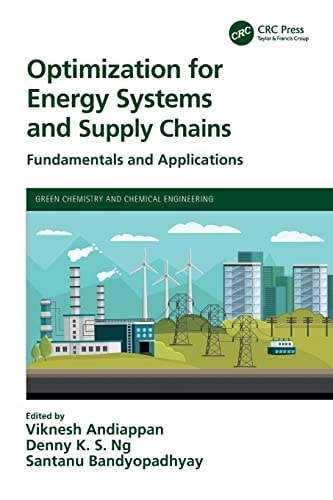
Optimization for Energy Systems and Supply Chains
0
0
As an Amazon Associate and affiliate partner, Menrva Books earns from qualifying purchases. Learn more
Author Description
To curb the impacts of rising CO2 emissions, the Intergovernmental Panel on Climate Change report states that a net zero target needs to be achieved by the year 2055. Experts argue that this is a critical time to make important and accurate decisions. Thus, it is essential to have the right tools to efficiently plan and deploy future energy systems and supply chains. Mathematical models can provide decision-makers with the tools required to make well-informed decisions relating to development of energy systems and supply chains. This book provides an understanding of the various available energy systems, the basics behind mathematical models, the steps required to develop mathematical models, and examples/case studies where such models are applied. Divided into two parts, one covering basics for beginners and the other featuring contributed chapters offering illustrative examples, this book: Shows how mathematical models are applied to solve problems in energy systems and supply chains Provides fundamentals of the working principles of various energy systems and their technologies Offers basics of how to formulate and best practices for developing mathematical models, topics not covered in other titles Features a wide range of case studies Teaches readers to develop their own mathematical models to make decisions on energy systems This book is aimed at chemical, process, mechanical, and energy engineers.
Menrva's Summary
THE THESIS
Mathematical models are crucial tools for decision-makers navigating the urgent need to achieve net-zero emissions by 2055. This book addresses the critical challenge of planning and deploying future energy systems and supply chains efficiently by providing a comprehensive understanding of mathematical modeling techniques. It covers the fundamentals of various energy systems, the principles behind mathematical models, and the practical steps for their development, supported by real-world case studies. The text is structured into two parts: an introductory section for beginners and a collection of contributed chapters showcasing illustrative examples of model application.
THE SCOPE MAP
- Fundamentals of the working principles of various energy systems and their technologies.
- Basics of how to formulate and best practices for developing mathematical models.
- Application of mathematical models to solve problems in energy systems and supply chains.
- Coverage of topics not commonly found in other titles related to mathematical model development.
- A wide range of case studies illustrating practical applications.
- Guidance for readers to develop their own mathematical models for decision-making in energy systems.
THE AUTHORITY PERSPECTIVE
This book is designed for chemical, process, mechanical, and energy engineers seeking to understand and apply mathematical models for energy systems and supply chains. The structure, divided into beginner-friendly basics and advanced contributed chapters, suggests a pedagogical approach aimed at both new and experienced practitioners. By focusing on practical application and model development, it aims to equip readers with the tools necessary for informed decision-making in the context of critical climate targets.
Page Count:
240
Publication Date:
2022-12-08
Publisher:
Taylor & Francis
ISBN-10:
1000801454
ISBN-13:
9781000801453
Non-Fiction
Business
Science & Technology
Climate Change
Mathematical Modeling
Energy Systems
Engineering
Community Tags
Similar Books