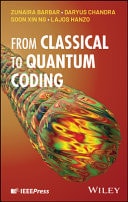
From Classical to Quantum Coding
0
0
As an Amazon Associate and affiliate partner, Menrva Books earns from qualifying purchases. Learn more
Author Description
An expert discussion of the potential evolution of quantum codes In From Classical to Quantum Coding, a team of distinguished researchers deliver a seamless research monograph on the subject of quantum error correction codes (QECC) designed for mitigating the environment-induced decoherence imposed on quantum computing and communications. Commencing from first principles, Part I is dedicated to readers familiar with classical coding and wishing to move into quantum coding. Part II focuses on near-term quantum codes requiring a modest to moderate number of qubits. Finally, Part III of the book offers an outlook on the classical to quantum evolution of QECCs, to advanced codes that rely on numerous qubits as quantum technology matures. The book incorporates several advanced topics, including the universal decoding of arbitrary linear codes, iterative short turbo block codes, turbo convolutional codes, and the family of low-density parity check codes. The powerful design tool of extrinsic information transfer charts plays a central role in the associated near-hashing-bound designs. Readers will also find: An easy-reading introduction to quantum information processing and quantum coding An evolutionary portrayal of the classical to quantum coding paradigm Practical discussions of near-term quantum topological error correction codes and how they protect quantum gates from decoherence Detailed treatments of syndrome-based decoding of diverse quantum turbo codes and quantum low-density parity check codes From Classical to Quantum Coding will benefit doctoral students, industrial and academic researchers wishing to expand their expertise from the classical to the quantum field of signal processing, computing and communications.
Menrva's Summary
THE THESIS
This book investigates the evolution of quantum error correction codes (QECC) from classical coding principles to advanced, qubit-intensive quantum technologies. The authors, distinguished researchers in the field, present a comprehensive research monograph that begins with fundamental concepts for those transitioning from classical to quantum coding. Subsequent sections delve into near-term quantum codes requiring moderate qubit counts and conclude with an outlook on future QECCs for mature quantum technologies. The work incorporates advanced topics such as universal decoding, turbo codes, and low-density parity check codes, utilizing extrinsic information transfer charts for near-hashing-bound designs.
THE SCOPE MAP
- An accessible introduction to quantum information processing and quantum coding.
- An evolutionary perspective on the paradigm shift from classical to quantum coding.
- Practical discussions on near-term quantum topological error correction codes and their role in protecting quantum gates.
- Detailed treatments of syndrome-based decoding for various quantum turbo codes and quantum low-density parity check codes.
THE AUTHORITY PERSPECTIVE
The book is positioned as a research monograph for doctoral students and researchers transitioning from classical to quantum fields. Its structure, progressing from foundational principles to advanced topics, suggests a comprehensive and systematic approach to quantum error correction. The inclusion of specific advanced topics like turbo codes and LDPC codes, along with the use of extrinsic information transfer charts, indicates a focus on practical design tools and near-hashing-bound solutions. The work aims to equip readers with expertise in quantum signal processing, computing, and communications.
Page Count:
288
Publication Date:
2025-11-01
Publisher:
Wiley
ISBN-10:
1394331932
ISBN-13:
9781394331932
Science
Non-Fiction
Communications
Coding Theory
Community Tags
Similar Books