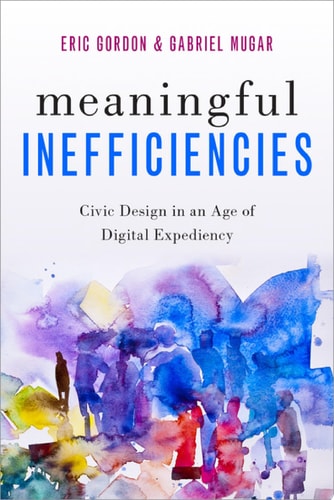
Meaningful Inefficiencies: Civic Design in an Age of Digital Expediency
0
0
As an Amazon Associate and affiliate partner, Menrva Books earns from qualifying purchases. Learn more
Author Description
Public trust in the institutions that mediate civic life-from governing bodies to newsrooms-is low. In facing this challenge, many organizations assume that ensuring greater efficiency will build trust. As a result, these organizations are quick to adopt new technologies to enhance what they do, whether it's a new app or dashboard. However, efficiency, or charting a path to a goal with the least amount of friction, is not itself always built on a foundation of trust. Meaningful Inefficiencies is about the practices undertaken by civic designers that challenge the normative applications of "smart technologies" in order to build or repair trust with publics. Based on over sixty interviews with change makers in public serving organizations throughout the United States, as well as detailed case studies, this book provides a practical and deeply philosophical picture of civic life in transition. The designers in this book are not professional designers, but practitioners embedded within organizations who have adopted an approach to public engagement Eric Gordon and Gabriel Mugar call "meaningful inefficiencies," or the deliberate design of less efficient over more efficient means of achieving some ends. This book illustrates how civic designers are creating meaningful inefficiencies within public serving organizations. It also encourages a rethinking of how innovation within these organizations is understood, applied, and sought after. Different than market innovation, civic innovation is not just about invention and novelty; it is concerned with building communities around novelty, and cultivating deep and persistent trust. At its core, Meaningful Inefficiencies underlines that good civic innovation will never just involve one single public good, but must instead negotiate a plurality of publics. In doing so, it creates the conditions for those publics to play, resulting in people truly caring for the world. Meaningful Inefficiencies thus presents an emergent and vital
Menrva's Summary
THE THESIS
Does the pursuit of digital efficiency in public institutions inadvertently erode the very trust it seeks to build? Eric Gordon and Gabriel Mugar, both scholars in civic media and design, argue that the obsession with frictionless technology often undermines democratic engagement. They propose a framework of 'meaningful inefficiencies'—the intentional design of processes that prioritize human connection and public trust over mere speed or technical optimization.
THE SCOPE MAP
What You Will Find
- Analysis of civic innovation within public-serving organizations.
- A conceptual framework for evaluating the trade-offs between digital speed and social trust.
- Detailed case studies of practitioners implementing non-traditional engagement strategies.
Scope Limits
- The text focuses primarily on the United States context.
- It does not provide a technical manual for software development or specific app engineering.
THE AUTHORITY PERSPECTIVE
Experts in urban planning and civic technology recognize this work as a critical intervention in the discourse surrounding 'smart city' initiatives. Readers frequently note the philosophical density of the prose, which challenges practitioners to reconsider the long-term social costs of rapid technological adoption.
Page Count:
199
Publication Date:
2020-01-01
Publisher:
Oxford University Press
ISBN-10:
0190870168
ISBN-13:
9780190870164
Urban policy
Technology & Engineering
Sociology
urban planning
Civic Design
Introduction to Human Communication
Public Policy
Trades & Technology
Technology and Society
Communications
United States
Human services
Community Tags
Similar Books










Reader Comments
Share Your Thoughts
No comments yet. Be the first to share your thoughts!