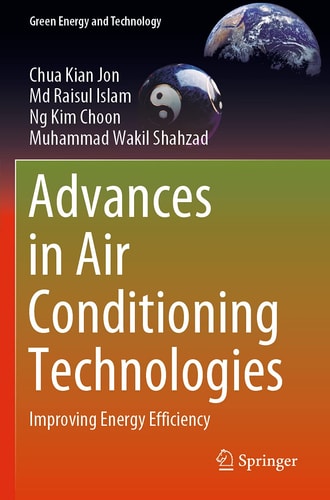
Advances in Air Conditioning Technologies Improving Energy Efficiency
0
0
As an Amazon Associate and affiliate partner, Menrva Books earns from qualifying purchases. Learn more
Author Description
This book highlights key recent developments in air conditioning technologies for cooling and dehumidification with the specific objectives to improve energy efficiency and to minimize environmental impact. Today, air conditioning, comprising cooling and dehumidification, is a necessity in commercial and residential buildings and even in many industrial processes. This book provides key update on recent developments in air conditioning systems, cooling cycles and innovative cooling/dehumidification technologies. Key technologies related to cooling include heat-driven absorption and adsorption cooling and water-based dew point evaporative cooling. Technologies connected with dehumidification involve new generations of adsorbent–desiccant dehumidifiers, liquid-based desiccants and membranes that sieve out water vapor from air. Losses in cooling cycles and thermo-economic analysis for a sustainable economy are also judiciously documented.
Menrva's Summary
THE THESIS
This book investigates recent advancements in air conditioning technologies aimed at enhancing energy efficiency and reducing environmental impact. The authors present key updates on air conditioning systems, cooling cycles, and innovative cooling and dehumidification technologies. It details heat-driven absorption and adsorption cooling, water-based dew point evaporative cooling, and new generations of adsorbent-desiccant dehumidifiers, liquid-based desiccants, and membrane technologies. The text also addresses losses in cooling cycles and provides thermo-economic analysis for a sustainable economy.
THE SCOPE MAP
- Recent developments in air conditioning technologies for cooling and dehumidification.
- Focus on improving energy efficiency and minimizing environmental impact.
- Key update on recent developments in air conditioning systems and cooling cycles.
- Innovative cooling technologies including heat-driven absorption and adsorption cooling.
- Water-based dew point evaporative cooling technologies.
- Dehumidification technologies such as new adsorbent-desiccant dehumidifiers and liquid-based desiccants.
- Membrane technologies for water vapor removal from air.
- Documentation of losses in cooling cycles and thermo-economic analysis for sustainability.
THE AUTHORITY PERSPECTIVE
This book offers a comprehensive overview of cutting-edge air conditioning technologies, focusing on energy efficiency and environmental sustainability. The detailed examination of various cooling and dehumidification methods, from absorption and adsorption cycles to advanced membrane technologies, positions it as a valuable resource for researchers and engineers in the field. The inclusion of thermo-economic analysis further supports its relevance for developing sustainable solutions in HVAC systems. The text provides a thorough update on recent progress, making it a significant contribution to the literature on climate control technologies.
Page Count:
305
Publication Date:
2021-10-23
Publisher:
Springer Nature Singapore
ISBN-10:
9811584796
ISBN-13:
9789811584794
Non-Fiction
Science
Engineering
HVAC
Energy Efficiency
Thermodynamics
Community Tags
Similar Books