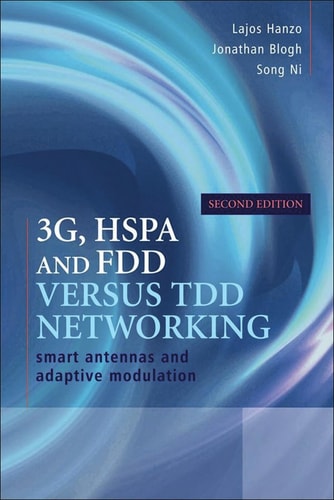
3G, HSPA and FDD versus TDD Networking
0
0
As an Amazon Associate and affiliate partner, Menrva Books earns from qualifying purchases. Learn more
Author Description
3G, HSPA and FDD versus TDD Networking, Second Edition is the only book that contrasts the network capacity gains that may be achieved with the advent of adaptive antenna arrays and HSDPA-style adaptive modulation techniques in the context of FDD and TDD CDMA cellular networks. In the five years since the first edition of this book was published the wireless landscape has evolved further. The new book addresses the recent developments in the field of HSDPA-style wireless networking, focusing particularly on the issues and challenges of FDD versus TDD networking. These solutions are particularly powerful in shadow-faded scenarios, when the antenna array elements experience correlated, rather than independent fading. Furthermore, the flexible up-link/down-link time-slot allocation of TDD is beneficial for supporting the Wireless Internet, but results in erratic interference fluctuations, which is efficiently combated by the antenna arrays and adaptive modulation. Additionally, whilst the adaptive modulation aided system simply drops the instantaneous transmission rate during instances of high interference, conventional networks would drop the call. Builds on successful previous edition to include recent developments in the field of HSDPA-style wireless networking Provides an all-encompassing self-contained overview of the subject for a wide range of readers of all levels. Treats the topics of both physical-layer and network-layer aspects of wireless systems using a cross-layer optimization approach. One of the first books to contrast in detail both FDD and TDD networking. The material is presented clearly and logically allowing the uninitiated reader to commence reading it at fundamental non-mathematical conceptual level at the beginning of the book, while advanced readers can turn directly to the required chapter describing solutions to a number of wireless FDD or TDD networking problems. This book will inspi
Menrva's Summary
THE THESIS
This book investigates the capacity gains achievable in 3G, HSPA, and FDD/TDD CDMA cellular networks through the integration of adaptive antenna arrays and adaptive modulation techniques. It builds upon the first edition by detailing recent advancements in HSDPA-style wireless networking, with a particular focus on the challenges and solutions for FDD versus TDD networking. The text explores how these techniques are especially effective in shadow-faded environments where antenna elements experience correlated fading, and how TDD's flexible time-slot allocation, while beneficial for the Wireless Internet, can be managed to combat erratic interference fluctuations. The book also contrasts the adaptive modulation system's approach of dropping transmission rates during high interference with conventional networks' practice of dropping calls.
THE SCOPE MAP
- Contrasts network capacity gains with adaptive antenna arrays and HSDPA-style adaptive modulation in FDD and TDD CDMA cellular networks.
- Addresses recent developments in HSDPA-style wireless networking, focusing on FDD versus TDD networking issues.
- Explains the benefits of adaptive techniques in shadow-faded scenarios with correlated antenna element fading.
- Discusses TDD's flexible up-link/down-link time-slot allocation for Wireless Internet support and interference management.
- Compares adaptive modulation's rate reduction during high interference with conventional network call drops.
- Covers both physical-layer and network-layer aspects of wireless systems using a cross-layer optimization approach.
- Presents material from a fundamental conceptual level to advanced problem-solving chapters.
THE AUTHORITY PERSPECTIVE
This book is recognized for providing a detailed contrast between FDD and TDD networking, a topic of significant importance in wireless communications. It is structured to accommodate readers of varying expertise, starting with fundamental concepts and progressing to advanced problem-solving. The inclusion of recent developments in HSDPA-style wireless networking ensures its relevance for professionals and researchers in the field.
Page Count:
596
Publication Date:
2008-03-31
Publisher:
Wiley
ISBN-10:
0470754206
ISBN-13:
9780470754207
Science
Science & Technology
Telecommunications
Engineering
Community Tags
Similar Books














Reader Comments
Share Your Thoughts
No comments yet. Be the first to share your thoughts!