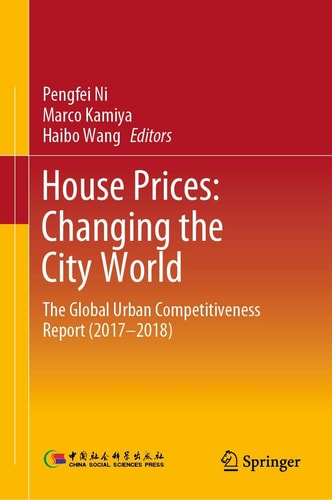
House Prices: Changing the City World - The Global Urban Competitiveness Report (2017–2018)
0
0
As an Amazon Associate and affiliate partner, Menrva Books earns from qualifying purchases. Learn more
Author Description
This report was jointly launched by the National Academy of Economic Strategy of the Chinese Academy of Social Sciences and UN-HABITAT. Using the indicator system and objective data, the competitiveness of 1,035 global cities was evaluated in detail. The report measures the development pattern of global urban competitiveness as a whole, and the gap between the relevant parties and the ideal state. It has refreshed people's past perceptions of urban rankings and confirmed that the science and technology innovation center cities and central cities of emerging economies have begun to break the inherent global cities and they have entered the ranks of the most urban competitiveness.While paying attention to the comparison of competitiveness among cities, this report further promotes the perspective to the pattern and trend change of global economic and social development from the perspective of city. The followings are new findings: First, information technology has increasingly become the primary driving force for urban development; Second, it is the three meridians that divide the global urban population and economic differentiation; Third, the soft links between cities gradually dominate the global urban system; Fourth, the formation of new global cities is beginning.
Menrva's Summary
THE THESIS
This report investigates the evolving landscape of global urban competitiveness and its impact on city development. The study, a collaboration between the Chinese Academy of Social Sciences and UN-HABITAT, evaluates 1,035 cities using a comprehensive indicator system and objective data. It challenges traditional urban rankings by highlighting the rise of science and technology innovation centers and emerging economies, which are disrupting the established order of global cities. The report also examines broader trends in global economic and social development as viewed through the lens of urban dynamics.
THE SCOPE MAP
- Evaluation of the competitiveness of 1,035 global cities.
- Analysis of the development pattern of global urban competitiveness and the gap to an ideal state.
- Identification of information technology as a primary driver of urban development.
- Examination of three meridians that divide global urban population and economic differentiation.
- Exploration of the increasing dominance of soft links in the global urban system.
- Discussion on the formation of new global cities and their impact.
THE AUTHORITY PERSPECTIVE
This report is a collaborative effort by established institutions, suggesting a data-driven and analytical approach to urban competitiveness. The findings aim to refresh perceptions of urban rankings and highlight emerging trends, such as the influence of information technology and the rise of new global cities. The scope of the analysis, covering over a thousand cities, indicates a comprehensive overview of global urban economic and social development patterns. Its focus on objective data and indicator systems positions it as a resource for understanding contemporary urban dynamics.
Page Count:
618
Publication Date:
2019-12-04
Publisher:
Springer Nature Singapore
ISBN-10:
9813291109
ISBN-13:
9789813291102
Business
Non-Fiction
Economics
Data Analysis
urban planning
Real Estate
Global Studies
Community Tags
Similar Books