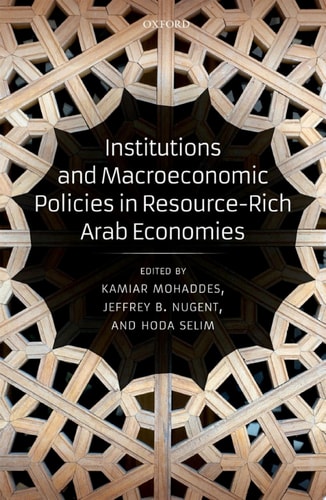
Institutions and Macroeconomic Policies in Resource-Rich Arab Economies
0
0
As an Amazon Associate and affiliate partner, Menrva Books earns from qualifying purchases. Learn more
Author Description
For over eighty years the Arab region has been deriving massive wealth from its natural resources. Nevertheless, its economic performance has been at the mercy of ebbs and flows of oil prices and its resources have been slowly depleting. The two critical questions are why and how Arab countries might escape the oil curse. Institutions and Macroeconomic Policies in Resource-Rich Arab Economies focuses on the unique features of the Arab world to explain the disappointing outcomes of macroeconomic policy. It explores the interaction between oil and institutions to draw policy recommendations on how Arab countries can best exploit their oil revenues to avoid the resource curse. Case studies and contributions from experts provide an understanding of macroeconomic institutions (including their underlying rules, procedures and institutional arrangements) in oil-rich Arab economies and of their political economy environment, which has largely been overlooked in previous research. Institutions and Macroeconomic Policies in Resource-Rich Arab Economies offers novel macroeconomic policy propositions for exchange rate regimes, fiscal policy and oil wealth distribution that is more consistent with macroeconomic stability and fiscal sustainability. These policy reforms, if implemented successfully, could go a long way in helping the resource-rich countries of the Arab region and elsewhere to avoid the oil curse.
Menrva's Summary
THE THESIS
This book investigates why resource-rich Arab economies have historically struggled to translate oil wealth into sustained economic performance and how institutional reforms can mitigate the resource curse. The authors, Hoda Selim, Jeffrey B. Nugent, and Kamiar Mohaddes, utilize a combination of political economy analysis and macroeconomic theory to evaluate the structural weaknesses within these nations. By examining the interplay between oil revenues and institutional frameworks, the text argues that current policy failures stem from inadequate rules and procedures rather than the mere presence of natural resources.
THE SCOPE MAP
What You Will Find
- Analysis of macroeconomic institutions including fiscal rules and exchange rate regimes.
- Examination of the political economy environment specific to the Arab region.
- Policy recommendations for oil wealth distribution and fiscal sustainability.
- Comparative case studies of resource-rich Arab economies.
Scope Limits
- The text does not provide a comprehensive history of global oil markets outside the context of the Arab region.
- It does not offer granular microeconomic analysis of individual corporate entities within the energy sector.
THE AUTHORITY PERSPECTIVE
Experts highlight this work as a significant contribution to the literature on the resource curse, specifically for its focus on the often-overlooked institutional landscape of the Arab world. Readers frequently note the academic density of the prose, which serves as a rigorous resource for policymakers and scholars in development economics.
Page Count:
463
Publication Date:
2019-01-01
Publisher:
OUP Oxford
ISBN-10:
0192555383
ISBN-13:
9780192555380
Economics
Real Estate
Macroeconomics
Middle East
Natural Resources
Professional Career & Trade
Principles of Macroeconomics