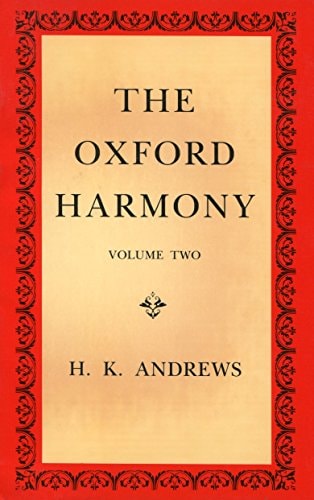
The Oxford Harmony: Volume Two
0
0
As an Amazon Associate and affiliate partner, Menrva Books earns from qualifying purchases. Learn more
Author Description
The Oxford Harmony is designed to give a complete practical course of instruction in all branches of the subject. It consists of two volumes, of which this is the second. In Chapters I-XII Andrews discusses the development of chromatic harmony and modulation, with numerous illustrations from standard classics. In the remaining eight chapters he deals with writing for strings, pianoforte accompaniments, setting words to music, unaccompanied choral writing, the harmonization of figured and ground bases, and pedal notes. There are also thirty0four exercises to be worked by the student. Throughout the book emphasis is laid on the actual practice of composers whose work has stood the test of time, rather than on cut and dried text-book rules. While examination requirements have been carefully borne in mind, the discussions of many problems of composition in particular can be enjoyed by anyone interested in the subject. English composer and organist Herbert Kennedy Andrews (1904-1965) was born in County Down and educated Bedford School and the Royal College of Music, London. Andrews earned two doctorates in music from Trinity College, Dublin, and New College, Oxford. He was organist and choirmaster at Beverley Minster, 1934-1938 and was appointed organist at New College, Oxford, in 1938. The remainder of his career was spent at Oxford, as a lecturer in music and subsequently Fellow of New College and Balliol. Andrews also taught at the Royal College of Music. His publications include An Introduction to the Technique of Palestrina (Novello, 1958); The Technique of Byrd's Vocal Polyphony (Oxford, 1966); and articles on early polyphonic music, particularly that of William Byrd.
Menrva's Summary
THE THESIS
This volume investigates the practical application of advanced harmonic techniques and compositional craft within the Western classical tradition. H. K. Andrews, a distinguished organist and academic, utilizes his extensive background in choral and instrumental music to provide a pedagogical framework. The text moves beyond abstract theory, grounding its arguments in the historical practices of established composers to guide students through complex musical problems.
THE SCOPE MAP
What You Will Find
- Analysis of chromatic harmony and modulation techniques
- Technical instruction for string writing and pianoforte accompaniment
- Methodologies for setting words to music and choral composition
- Thirty-four practical exercises for student application
Scope Limits
- Does not cover introductory music theory concepts found in the first volume
- Focuses primarily on Western classical conventions rather than contemporary or experimental styles
THE AUTHORITY PERSPECTIVE
Experts recognize this work as a rigorous, historically informed resource for serious music students and practitioners. Readers frequently note the academic density of the prose, which demands a solid foundation in musical literacy to fully utilize the provided exercises.
Page Count:
241
Publication Date:
1984-02-11
Publisher:
Oxford University Press
ISBN-10:
019321492X
ISBN-13:
9780193214927
Harmony
Academic
Reference
Music Education
Music Composition
Music theory
Community Tags
Similar Books