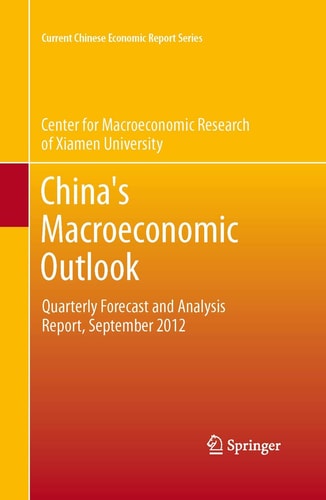
China's Macroeconomic Outlook Quarterly Forecast and Analysis Report, September 2012
0
0
As an Amazon Associate and affiliate partner, Menrva Books earns from qualifying purchases. Learn more
Author Description
Owing to the decline in domestic investment and trade with the rest of the world, China’s real GDP in the first half of 2012 was lower than expected. Based on forecasts from China’s Quarterly Macroeconomic Model (CQMM), the slowdown of the growth rate in 2013 will be moderate as a result of modestly proactive macro control policy. GDP would grow at 8.01 percent in 2012, and then rebound to 8.29 in 2013; CPI would fall to a 2.9 percent in 2012, and then would pick up to 3.27 percent in 2013. In the scenario in which the sovereign debt crisis in the euro area worsened in the second half of 2012, real GDP is forecast at 7.71 percent for 2012 and 7.5 percent for 2013. Even if the external economic environment becomes worse, China’s growth is expected to stay at above 7.5 percent, which might be a steady growth rate for the near future. If China plans to achieve a higher growth rate by launching the “2 trillion massive investment package”, the growth rate of GDP could be increased to 8.25 and 8.86 percent in 2012 and 2013 with a risk of inflation and worsening economic structure. The policy implication from CQMM: on one hand the Chinese government should be able to maintain the growth rate of around 8 percent by means of timely fine-tuning of monetary policies; on the other hand, the emphasis of the micro control should be placed on structural adjustments through fiscal policies. In the long run, deepening economic, social and institutional reform will be crucial to remove the significant structural imbalance and institutional barriers to market competition, to accelerate the transformation of economic development patterns, and finally to maintain a sustainable growth rate.
Menrva's Summary
THE THESIS
The central question of this report is the macroeconomic outlook for China in late 2012 and 2013, amidst a global economic slowdown and domestic investment decline. The report analyzes China's real GDP growth, Consumer Price Index (CPI), and potential policy interventions using the China Quarterly Macroeconomic Model (CQMM). It forecasts moderate growth in 2013, with GDP expected to reach 8.29 percent, and CPI picking up to 3.27 percent, contingent on proactive macroeconomic control policies. The analysis also considers a downside scenario where a worsening Eurozone debt crisis could reduce GDP growth to 7.5 percent in 2013, while also exploring the potential impact of a massive investment package on growth and inflation.
THE SCOPE MAP
- Forecasts for China's real GDP growth in 2012 and 2013.
- Projections for China's Consumer Price Index (CPI) in 2012 and 2013.
- Analysis of the impact of domestic investment and global trade on China's economy.
- Scenario modeling for a worsening Eurozone sovereign debt crisis.
- Evaluation of a potential "2 trillion massive investment package" and its risks.
- Policy implications for monetary and fiscal policies.
- Long-term recommendations for sustainable growth through structural reforms.
THE AUTHORITY PERSPECTIVE
This report, published in September 2012, provides a detailed macroeconomic forecast for China. It utilizes the China Quarterly Macroeconomic Model (CQMM) to project GDP and CPI figures for 2012 and 2013, considering various global and domestic economic factors. The analysis highlights the importance of proactive macroeconomic control and structural adjustments through fiscal policies. It also emphasizes the necessity of long-term economic, social, and institutional reforms to ensure sustainable growth and address structural imbalances.
Page Count:
40
Publication Date:
2012-09-01
Publisher:
Springer Berlin Heidelberg
ISBN-10:
3642437567
ISBN-13:
9783642437564
Non-Fiction
Economics
Business
Forecasting
Community Tags
Similar Books