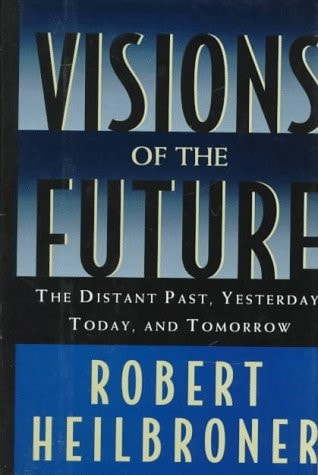
Visions of the Future: The Distant Past, Yesterday, Today, and Tomorrow
0
0
As an Amazon Associate and affiliate partner, Menrva Books earns from qualifying purchases. Learn more
Author Description
"This is an exceedingly long short book, stretching at least fifty thousand years into the past and who knows how many into the future..." So begins Visions of the Future, the prophetic new book by eminent economist Robert Heilbroner. Heilbroner's basic premise is stunning in its elegant simplicity. He contends that throughout all of human history, despite the huge gulf in social organization, technological development and cultural achievement that divides us from the earliest known traces of homo sapiens, there have really only been three distinct ways of looking at the future. During a period Heilbroner refers to simply as the Distant Past, stretching from prehistory to the appearance of modern nation-states in seventeenth century Europe, there was no notion of a future measurably and materially different from the present or the past. From the Stone Age to the Bronze, Mesopotamia and Egypt to Greece and Rome, and throughout the Middle Ages, a continuum of cultures and civilizations shared one defining characteristic, and that was the absence of any expectation of material progress for the great masses of people.Heilbroner maintains that it was not until the first stirrings of the period he refers to as Yesterday, spanning from roughly 1700 to 1950, that the future entered into human consciousness as a great beckoning force. Capitalism, continually reinvigorated by the seemingly endless forward march of science and an evolving sense of democracy, appeared to promise all levels of society some expectation of a future at least somewhat better than the past. It was this unwavering faith in the superiority of the future that separated Yesterday from the age we have now entered. While we are still driven towards tomorrow by the same forces that determined the recent past, the lessons of Hiroshima and Chernobyl, the chaos in the former Soviet Union, the stagnation of the West, and the anarchic rage unleashed in our inner cities and in hot spots around the globe have brou
Menrva's Summary
THE THESIS
This work investigates the evolution of human perception regarding the future and how shifting expectations of progress have defined distinct historical epochs. Robert Heilbroner, a renowned economist and social theorist, utilizes a broad historical framework to categorize human history into three distinct eras: the Distant Past, Yesterday, and the contemporary age. He argues that the concept of a materially different future is a relatively recent development, emerging only with the rise of capitalism and scientific advancement, and now faces a crisis of confidence due to modern global instability.
THE SCOPE MAP
What You Will Find
- A tripartite historical framework dividing human history into the Distant Past, Yesterday, and the modern era.
- Analysis of the transition from pre-modern cyclical time to the modern expectation of material progress.
- Examination of how capitalism and scientific development shaped the consciousness of the 18th through 20th centuries.
- Critical assessment of how contemporary events like technological disasters and geopolitical instability challenge the modern faith in the future.
THE AUTHORITY PERSPECTIVE
Experts recognize this text as a concise yet intellectually dense exploration of historical consciousness and economic philosophy. Readers frequently note that Heilbroner’s prose is accessible to non-specialists while providing a rigorous analytical structure for understanding the trajectory of modern society.
Page Count:
144
Publication Date:
1995-01-26
Publisher:
Oxford University Press
ISBN-10:
0195090748
ISBN-13:
9780195090741
Philosophy
Economics
History
Sociology
Forecasting
Future Studies
Community Tags
Other Editions(2)
Similar Books










Reader Comments
Share Your Thoughts
No comments yet. Be the first to share your thoughts!