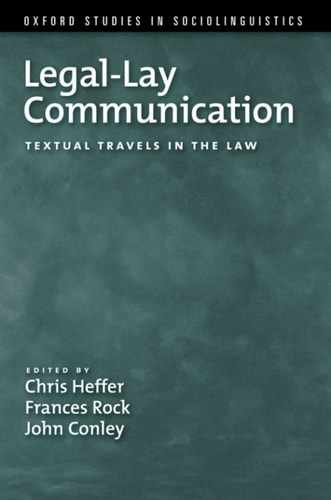
Legal-Lay Communication
0
0
As an Amazon Associate and affiliate partner, Menrva Books earns from qualifying purchases. Learn more
Author Description
This volume responds to a growing interest in the language of legal settings by situating the study of language and law within contemporary theoretical debates in discourse studies, linguistic anthropology, and sociolinguistics. The chapters in the collection explore many of the common occasions when those acting on behalf of the legal system, such as the police, lawyers and judges, interact with those coming into contact with the legal system, such as suspects and witnesses. However the chapters do this work through the conceptual lens of 'textual travel', or the way that texts move across space and time and are transformed along the way. Collectively, notions of textual travel shed new light on the ways in which texts can influence, and are influenced by, social and legal life. With contributions from leading experts in language and law, Legal-Lay Communication explores such 'textual travel' themes as the mediating role of technologies in the investigatory stages of the legal process, the centrality of intertextuality in the legal construction of cases in court, the transformative effects of recontextualization in processes of judicial decision-making, and the way that processes of textual travel disturb the apparent permanence of legal categorization. The book challenges both the notion of legal text as a static repository of meaning and the very idea of legal-lay or lay-legal communication.
Menrva's Summary
THE THESIS
This volume investigates the complex dynamics of communication between legal professionals and the public, examining how legal texts and language transform as they move through different contexts. The book addresses the growing interest in the language of legal settings by integrating contemporary theoretical debates in discourse studies, linguistic anthropology, and sociolinguistics. It explores interactions between legal system actors (police, lawyers, judges) and those encountering the system (suspects, witnesses), utilizing the concept of 'textual travel' to understand how texts are altered across space and time. This framework offers new insights into the reciprocal influence between texts and social/legal life, challenging static notions of legal meaning and communication.
THE SCOPE MAP
- Analysis of the mediating role of technologies in the investigatory stages of the legal process.
- Exploration of intertextuality in the legal construction of cases within court proceedings.
- Examination of the transformative effects of recontextualization in judicial decision-making.
- Discussion on how processes of textual travel disrupt the perceived permanence of legal categorization.
- Contributions from leading experts in the field of language and law.
- Focus on the conceptual lens of 'textual travel' to understand linguistic transformations.
- Investigates common occasions of interaction between legal professionals and the public.
THE AUTHORITY PERSPECTIVE
This collection is regarded as a significant contribution to the study of language and law, offering a novel perspective through the lens of 'textual travel'. The chapters collectively challenge traditional views of legal texts as static repositories of meaning and question the very nature of legal-lay communication. Experts in the field provide analyses that shed new light on how language functions within legal contexts, particularly concerning the influence of technology, intertextuality, and recontextualization. The work is noted for its theoretical grounding in discourse studies, linguistic anthropology, and sociolinguistics, appealing to academics and researchers in these areas.
Page Count:
352
Publication Date:
2013-07-16
Publisher:
Oxford University Press Academic US
ISBN-10:
0199359202
ISBN-13:
9780199359202
Non-Fiction
Literary Fiction
Discourse Analysis
Linguistics
Law
Community Tags
Similar Books