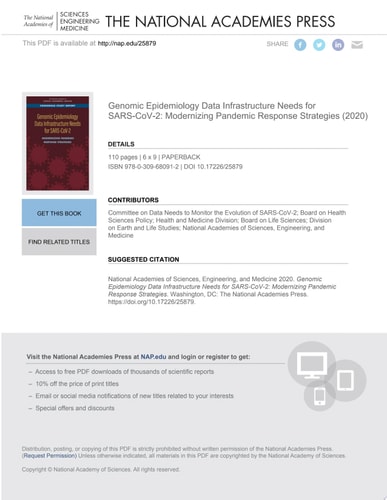
Genomic Epidemiology Data Infrastructure Needs for SARS-CoV-2: Modernizing Pandemic Response Strategies
0
0
As an Amazon Associate and affiliate partner, Menrva Books earns from qualifying purchases. Learn more
Author Description
In December 2019, new cases of severe pneumonia were first detected in Wuhan, China, and the cause was determined to be a novel beta coronavirus related to the severe acute respiratory syndrome (SARS) coronavirus that emerged from a bat reservoir in 2002. Within six months, this new virus—SARS coronavirus 2 (SARS-CoV-2)—has spread worldwide, infecting at least 10 million people with an estimated 500,000 deaths. COVID-19, the disease caused by SARS-CoV-2, was declared a public health emergency of international concern on January 30, 2020 by the World Health Organization (WHO) and a pandemic on March 11, 2020. To date, there is no approved effective treatment or vaccine for COVID-19, and it continues to spread in many countries. Genomic Epidemiology Data Infrastructure Needs for SARS-CoV-2: Modernizing Pandemic Response Strategies lays out a framework to define and describe the data needs for a system to track and correlate viral genome sequences with clinical and epidemiological data. Such a system would help ensure the integration of data on viral evolution with detection, diagnostic, and countermeasure efforts. This report also explores data collection mechanisms to ensure a representative global sample set of all relevant extant sequences and considers challenges and opportunities for coordination across existing domestic, global, and regional data sources.
Menrva's Summary
THE THESIS
This report addresses the critical need for robust data infrastructure to track the evolution of SARS-CoV-2 and inform pandemic response strategies. The COVID-19 pandemic, caused by SARS-CoV-2, has highlighted deficiencies in global systems for correlating viral genomic sequences with clinical and epidemiological data. This report outlines a framework for such a system, aiming to integrate data on viral evolution with efforts in detection, diagnostics, and countermeasures. It also examines mechanisms for collecting representative global sequence samples and addresses challenges in coordinating diverse data sources.
THE SCOPE MAP
- Framework for defining and describing data needs for SARS-CoV-2 genomic epidemiology.
- Integration of viral evolution data with detection, diagnostic, and countermeasure efforts.
- Mechanisms for ensuring a representative global sample set of viral sequences.
- Analysis of challenges and opportunities for coordinating domestic, global, and regional data sources.
- Discussion of data infrastructure requirements for modernizing pandemic response strategies.
THE AUTHORITY PERSPECTIVE
This report is a product of the National Academies of Sciences, Engineering, and Medicine, indicating a high level of expert review and synthesis. The content focuses on the technical and systemic requirements for genomic epidemiology data infrastructure, suggesting it is aimed at policymakers, public health officials, researchers, and data scientists involved in pandemic preparedness and response. The detailed framework and analysis of data needs position it as a foundational document for guiding future investments and policy decisions in this critical area.
Page Count:
110
Publication Date:
2020-10-29
Publisher:
National Academies Press
ISBN-10:
0309680913
ISBN-13:
9780309680912
Non-Fiction
Health
Science
Science & Technology
Genomics
Epidemiology
Public Health
Community Tags
Similar Books














Reader Comments
Share Your Thoughts
No comments yet. Be the first to share your thoughts!