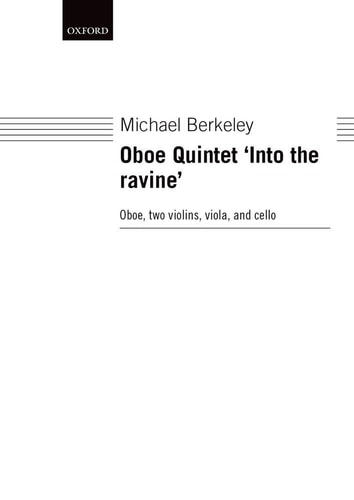
Oboe Quintet: Into the Ravine
0
0
As an Amazon Associate and affiliate partner, Menrva Books earns from qualifying purchases. Learn more
Author Description
While writing this quintet Berkeley had in mind the paintings of John Craxton and Mark Rothko, and the way in which paint can vibrate as colours collide. The piece opens with the oboe intoning three notes around which all the music oscillates. At pivotal moments in the music this lachrymose motif imposes itself though in varied permutations. In the final bars the oboe has a seagull-like cry until, as though a switch is pulled, its life force is suddenly cut off.
Menrva's Summary
THE THESIS
This work explores the intersection of visual art and musical composition, specifically investigating how the chromatic intensity of painters like John Craxton and Mark Rothko can be translated into sonic vibration. Michael Berkeley, a noted contemporary composer, utilizes this quintet to examine the structural potential of a single, recurring motif. By anchoring the entire composition around a three-note oboe sequence, the work argues that musical tension is best achieved through the oscillation and permutation of a central, lachrymose theme.
THE SCOPE MAP
What You Will Find
- A detailed analysis of the oboe's role as a primary melodic anchor.
- Exploration of the relationship between visual color theory and musical timbre.
- Structural breakdown of the piece's development from initial motif to final resolution.
Scope Limits
- The text does not provide a comprehensive biography of the composer.
- It does not offer a technical guide for oboe performance techniques.
THE AUTHORITY PERSPECTIVE
Musicologists and performers frequently note the high degree of technical precision required to execute the piece's abrupt shifts in tone. Experts highlight this work as a significant example of how modern chamber music can effectively synthesize influences from mid-century abstract expressionism.
Page Count:
64
Publication Date:
2012-01-01
Publisher:
Oxford University Press Music
ISBN-10:
0193390760
ISBN-13:
9780193390768
Music
Chamber Music
Contemporary Classical
Sheet Music
Musical Genres
Community Tags
Similar Books