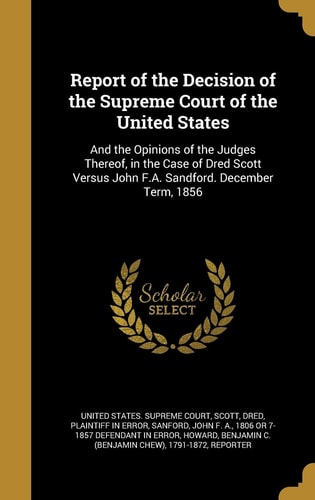
Report of the Decision of the Supreme Court of the United States And the Opinions of the Judges Thereof, in the Case of Dred Scott Versus John F.A. Sandford. December Term, 1856
0
0
As an Amazon Associate and affiliate partner, Menrva Books earns from qualifying purchases. Learn more
Author Description
This work has been selected by scholars as being culturally important, and is part of the knowledge base of civilization as we know it. This work was reproduced from the original artifact, and remains as true to the original work as possible. Therefore, you will see the original copyright references, library stamps (as most of these works have been housed in our most important libraries around the world), and other notations in the work. This work is in the public domain in the United States of America, and possibly other nations. Within the United States, you may freely copy and distribute this work, as no entity (individual or corporate) has a copyright on the body of the work. As a reproduction of a historical artifact, this work may contain missing or blurred pages, poor pictures, errant marks, etc. Scholars believe, and we concur, that this work is important enough to be preserved, reproduced, and made generally available to the public. We appreciate your support of the preservation process, and thank you for being an important part of keeping this knowledge alive and relevant.
Menrva's Summary
THE THESIS
The Supreme Court's landmark decision in Dred Scott v. Sandford fundamentally reshaped the understanding of citizenship and slavery in the United States. This ruling addressed whether African Americans, whether enslaved or free, could be considered citizens and therefore possess the rights afforded to citizens, including the right to sue in federal court. The Court, led by Chief Justice Roger B. Taney, determined that enslaved or formerly enslaved persons of African descent were not citizens and had no rights which the white man was bound to respect, effectively denying them legal standing and reinforcing the institution of slavery.
THE SCOPE MAP
- The legal arguments presented by both Dred Scott and John F.A. Sandford.
- The majority opinion delivered by Chief Justice Roger B. Taney.
- The dissenting opinions of Justices John McLean and Benjamin Robbins Curtis.
- The historical context of the case, including the Missouri Compromise.
- The legal status of African Americans as citizens in the United States.
- The implications of the ruling on the institution of slavery and states' rights.
- The impact of the decision on the lead-up to the American Civil War.
THE AUTHORITY PERSPECTIVE
This decision is widely regarded as one of the most infamous and consequential rulings in the history of the U.S. Supreme Court. It intensified sectional divisions, further polarizing the nation on the issue of slavery and contributing significantly to the outbreak of the Civil War. Legal scholars and historians continue to analyze its flawed reasoning and devastating impact on civil rights and the concept of citizenship.
Page Count:
256
Publication Date:
2016-08-28
Publisher:
Creative Media Partners, LLC
ISBN-10:
1372919309
ISBN-13:
9781372919305
Non-Fiction
History
Politics
Law
Community Tags
Similar Books