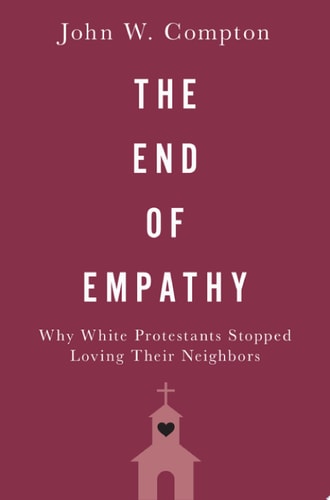
The End of Empathy: Why White Protestants Stopped Loving Their Neighbors
0
0
As an Amazon Associate and affiliate partner, Menrva Books earns from qualifying purchases. Learn more
Author Description
When polling data showed that an overwhelming 81% of white evangelicals had voted for Donald Trump in the 2016 presidential election, commentators across the political spectrum were left aghast. Even for a community that had been tracking further and further right for decades, this support seemed decidedly out of step. How, after all, could an amoral, twice-divorced businessman from New York garner such devoted admiration from the most vociferous of "values voters?" That this same group had, not a century earlier, rallied national support for such progressive causes as a federal minimum wage, child labor laws, and civil rights made the Trump shift even harder to square.In The End of Empathy, John W. Compton presents a nuanced portrait of the changing values of evangelical voters over the course of the last century. To explain the rise of white Protestant social concern in the latter part of the nineteenth century and its sudden demise at the end of the twentieth, Compton argues that religious conviction, by itself, is rarely sufficient to motivate empathetic political behavior. When believers do act empathetically--championing reforms that transfer resources or political influence to less privileged groups within society, for example--it is typically because strong religious institutions have compelled them to do so. Citizens throughout the previous century had sought membership in churches as a means of ensuring upward mobility, but a deterioration of mainline Protestant authority that started in the 1960s led large groups of white suburbanites to shift away from the mainline Protestant churches. There to pick up the slack were larger evangelical congregations with conservative leaders who discouraged attempts by the government to promote a more equitable distribution of wealth and political authority. That shift, Compton argues, explains the larger revolution in white Protestantism that brought us to this political moment.
Menrva's Summary
THE THESIS
This book investigates the historical transformation of white Protestant political behavior, specifically questioning why a demographic once supportive of progressive social reforms shifted toward conservative political alignment by the 21st century. John W. Compton, a scholar of political science, utilizes historical data and sociological analysis to argue that religious conviction alone does not dictate political empathy. Instead, he posits that the strength and institutional authority of churches historically served as the primary mechanism for compelling believers to support social welfare and equitable resource distribution. As mainline Protestant influence waned in the late 20th century, the rise of conservative evangelical congregations fundamentally altered the political priorities of their congregants.
THE SCOPE MAP
What You Will Find
- Historical analysis of white Protestant social advocacy from the late 19th century to the present.
- Examination of the correlation between church membership and upward mobility.
- Analysis of the decline of mainline Protestant authority starting in the 1960s.
- Investigation into the rise of conservative evangelical leadership and its impact on political voting patterns.
Scope Limits
- The text does not provide a comprehensive history of all American religious denominations.
- It does not focus on the theological nuances of evangelical doctrine, but rather on the institutional and political shifts within the community.
THE AUTHORITY PERSPECTIVE
Scholars and political analysts frequently cite this work for its rigorous institutional approach to understanding the modern evangelical voting bloc. Readers often note the academic density of the prose, which provides a structured framework for interpreting complex shifts in American political history.
Page Count:
408
Publication Date:
2020-01-01
Publisher:
Oxford University Press
ISBN-10:
0190069201
ISBN-13:
9780190069209
Politics
Philosophy
Religion
History
Sociology
Church Leadership
Protestant
Empathy
Politics & Government
Law
Religious
Social Science
Social Philosophy
Comparative
American History
Social Sciences - Religion - Christianity
Social History
West Indies
20th Century
Christianity and politics
General
Evangelicalism
New Used & Rental Textbooks
Church & State
Christian Denominations & Sects
Systems Theory
Church History
World
Community Tags
Similar Books