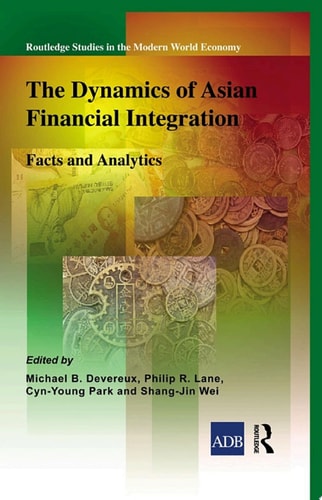
The Dynamics of Asian Financial Integration: Facts and Analytics
0
0
As an Amazon Associate and affiliate partner, Menrva Books earns from qualifying purchases. Learn more
Author Description
The ongoing global financial crisis has manifested a remarkable degree of global financial integration—and its implications—for emerging Asian financial markets. The current crisis will not and should not deter the progress that the region has made toward financial openness and integration. However, events like this clearly demonstrate that financial liberalization and integration is not without risks. Hence, emerging Asian economies' growing financial ties have motivated us to look closer at the repercussions of increased financial integration and evaluate the benefits of risk sharing and better access to international capital markets against the costs of cross-border financial contagion. The crisis also presents a timely opportunity for the region’s policy makers to rethink their strategies for financial deregulation and liberalization and to reconsider a next step to integrate emerging East Asia’s financial markets further. However, doing so requires deeper understanding of financial market integration. While much has been said in both academic and policy circles about financial globalization and regional financial integration as separate areas of study, existing research has been relatively silent on the dynamics between these two distinctive forces. The book addresses this gap in financial literature and assesses financial integration in emerging East Asia at both regional and global levels. The publication studies the factors driving the progress of regional financial integration in relation to financial globalization and identifies the relevant policy challenges facing emerging market economies in the region. Chapters look into three broad aspects of regional and global financial market integration: (i) measurement of regional and global financial integration, (ii) understanding dynamics of regional financial integration versus global financial integration, and (iii) welfare implications from regional financial market integration amid financ
Menrva's Summary
THE THESIS
This book investigates the complex interplay between global financial integration and the progress of financial openness in emerging Asian markets, particularly in the wake of the global financial crisis. The authors, a distinguished group of economists, examine the benefits of risk sharing and access to international capital against the costs of cross-border financial contagion. The book addresses a gap in existing research by exploring the dynamics between global financial globalization and regional financial integration, offering insights for policymakers seeking to navigate financial deregulation and liberalization strategies. It assesses financial integration in emerging East Asia at both regional and global levels, identifying key policy challenges.
THE SCOPE MAP
- Measurement of regional and global financial integration
- Understanding the dynamics of regional financial integration versus global financial integration
- Analysis of welfare implications from regional financial market integration amid financial crises
- Examination of the repercussions of increased financial integration in emerging Asian economies
- Evaluation of the benefits of risk sharing and access to international capital markets
- Assessment of the costs of cross-border financial contagion
- Policy recommendations for financial deregulation and liberalization strategies in emerging East Asia
THE AUTHORITY PERSPECTIVE
The book addresses a critical juncture for emerging Asian economies, offering a timely analysis of financial integration in the context of global financial instability. It aims to bridge the gap between studies on financial globalization and regional integration by examining their dynamic relationship. The work is positioned to inform policymakers grappling with the risks and rewards of financial liberalization. The authors' collective expertise suggests a rigorous academic treatment of the subject matter.
Page Count:
352
Publication Date:
2011-05-03
Publisher:
Routledge
ISBN-10:
1136847618
ISBN-13:
9781136847615
Non-Fiction
Business
Economics
Finance
International relations
Community Tags
Similar Books














Reader Comments
Share Your Thoughts
No comments yet. Be the first to share your thoughts!