Generative AI
0
0
As an Amazon Associate and affiliate partner, Menrva Books earns from qualifying purchases. Learn more
Author Description
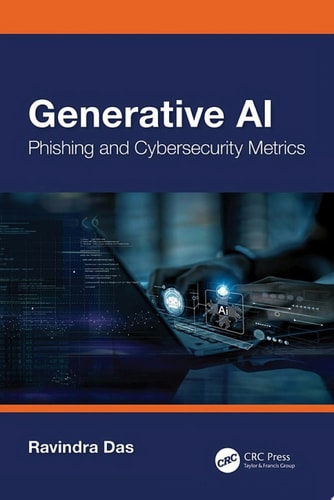
The cybersecurity landscape is changing, for sure. For example, one of the oldest threat variants is that of phishing. It evolved in the early 1990s, but even today it is still being used as a primary threat variant and has now become much more sophisticated, covert, and stealthy in nature. For example, it can be used to launch ransomware, social engineering, and extortion attacks. The advent of Generative AI is making this much worse. For example, a cyberattacker can now use something like ChatGPT to craft the content for phishing emails that are so convincing that it is almost impossible to tell the difference between what is real and what is fake. This is also clearly evident in the use of deepfakes, where fake images of real people are replicated to create videos to lure unsuspecting victims to a fake website. But Generative AI can also be used for the good to combat Phishing Attacks. This is the topic of this book. In this, we cover the following: A review of phishing A review of AI, Neural Networks, and Machine Learning A review of Natural Language Processing, Generative AI, and the Digital Person A proposed solution as to how Generative AI can combat phishing attacks as they relate to Privileged Access accounts
Menrva's Summary
THE THESIS
Generative AI presents a dual-edged sword in the ongoing battle against cyber threats, particularly phishing. The book explores how advancements in AI, neural networks, machine learning, and natural language processing, especially Generative AI, have amplified the sophistication of phishing attacks, making them harder to detect. However, it also posits that these same technologies can be harnessed to develop novel solutions to combat these evolving threats, focusing on their application against privileged access accounts.
THE SCOPE MAP
- A comprehensive review of phishing as a persistent cyber threat.
- An overview of Artificial Intelligence, Neural Networks, and Machine Learning.
- An exploration of Natural Language Processing, Generative AI, and Digital Person technology.
- A detailed proposal for utilizing Generative AI to combat phishing attacks.
- Specific focus on the application of Generative AI solutions for privileged access accounts.
THE AUTHORITY PERSPECTIVE
The book addresses a critical and timely intersection of rapidly advancing AI technology and persistent cybersecurity challenges. By examining the evolution of phishing and the capabilities of Generative AI, it aims to provide a forward-looking perspective on threat mitigation. The proposed solutions are likely to be of interest to cybersecurity professionals, AI researchers, and anyone concerned with digital security in the age of sophisticated AI-driven attacks.
Page Count:
175
Publication Date:
2024-10-10
Publisher:
Taylor & Francis
ISBN-10:
1040128149
ISBN-13:
9781040128145
Non-Fiction
Science & Technology
Technology
Machine Learning
Cybersecurity
Community Tags
Similar Books