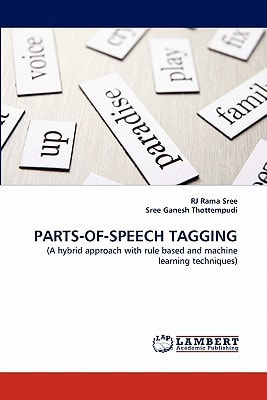
Parts-of-Speech Tagging
0
0
As an Amazon Associate and affiliate partner, Menrva Books earns from qualifying purchases. Learn more
Author Description
In corpus linguistics, part-of-speech tagging (POS tagging or POST), also called grammatical tagging or word-category disambiguation, is the process of marking up the words in a text (corpus) as corresponding to a particular part of speech, based on both its definition, as well as its context -ie. relationship with adjacent and related words in a phrase, sentence, or paragraph. A simplified form of this is commonly taught to school-age children, in the identification of words as nouns, verbs, adjectives, adverbs, etc. Once performed by hand, POS tagging is now done in the context of computational linguistics, using algorithms which associate discrete terms, as well as hidden parts of speech, in accordance with a set of descriptive tags. (wiki)
Menrva's Summary
THE THESIS
This book investigates the process and application of part-of-speech tagging within corpus linguistics and computational linguistics. It details how words in a text are marked with their grammatical function, considering both definitions and contextual relationships, and contrasts manual methods with modern algorithmic approaches. The authors, RJ Rama Sree and Sree Ganesh Thottempudi, draw upon established linguistic principles and computational techniques to explain this fundamental aspect of natural language processing.
THE SCOPE MAP
- The definition and historical context of part-of-speech tagging.
- The role of context and word relationships in disambiguation.
- The evolution from manual tagging to algorithmic approaches in computational linguistics.
- The use of descriptive tags to associate discrete terms with hidden parts of speech.
THE AUTHORITY PERSPECTIVE
This work appears to be a focused technical exposition on part-of-speech tagging, likely aimed at students or practitioners in computational linguistics or natural language processing. The description suggests a clear, structured explanation of a core concept in the field. Its reliance on established definitions and algorithmic processes indicates a text grounded in established academic principles rather than speculative theory.
Page Count:
180
Publication Date:
2011-05-01
Publisher:
Lap Lambert Academic Publishing GmbH KG
ISBN-10:
3843391483
ISBN-13:
9783843391481
Non-Fiction
Science & Technology
Computer Science
Computational linguistics
Corpus linguistics
Community Tags
Similar Books