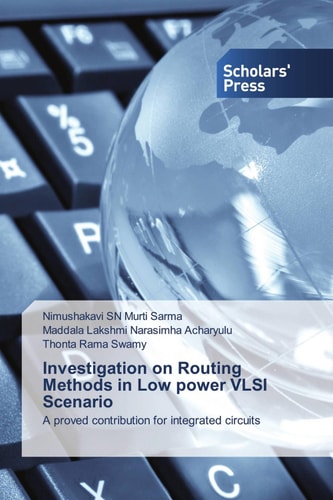
Investigation on Routing Methods in Low Power VLSI Scenario: A Proved Contribution for Integrated Circuits
0
0
As an Amazon Associate and affiliate partner, Menrva Books earns from qualifying purchases. Learn more
Author Description
The ever-increasing demand in new applications and compact devices resulted in developing new technologies in the integration level. Very large scale integration (VLSI) has given the advantage of integrating large density applications into a compact platform achieving the objective of obtaining high-end applications onto a single platform.With the increase in developing the integration density, this technology has evolved to Nanoscale designing, which gives a significant leap into the VLSI domain. With the achievement of large integration density, the constraints of power, speed and throughput are also increasing. As the transistor density increase, the power consumption too increases. This is a bottleneck for VLSI design for critical applications. Hence the need for lower power consumption is a major objective in the VLSI design environment. Power optimization is developed via multiple means, where researchers have an outcome with various approaches in composition level or integration level to reduce power dissipation. The processing power utilization is considered a useful consumption, however, power losses due to IR losses and electromagnetic interference (EMI) are investigated.
Menrva's Summary
THE THESIS
This book investigates methods for reducing power consumption in Very Large Scale Integration (VLSI) circuits, a critical challenge in modern electronic design. The authors address the increasing demand for compact, high-performance devices, which has led to advancements in integration density and nanoscale design. As transistor counts rise, so does power dissipation, creating a bottleneck for critical applications. This work explores various approaches at the composition and integration levels to mitigate power loss, focusing on reducing IR losses and electromagnetic interference (EMI) beyond essential processing power utilization.
THE SCOPE MAP
- Analysis of power consumption challenges in nanoscale VLSI design.
- Exploration of integration density and its impact on power, speed, and throughput.
- Methods for power optimization at the composition and integration levels.
- Investigation into power losses due to IR drop and electromagnetic interference (EMI).
- Discussion of the trade-offs between processing power utilization and power dissipation.
THE AUTHORITY PERSPECTIVE
This technical work appears to offer a focused contribution to the field of low-power VLSI design, addressing a significant challenge in modern electronics. Its detailed examination of power dissipation, IR losses, and EMI suggests it is aimed at researchers and engineers working within integrated circuit design. The authors' approach of investigating multiple means for power optimization indicates a comprehensive review of current methodologies.
Page Count:
204
Publication Date:
2021-06-22
Publisher:
Scholars' Press
ISBN-10:
6138955269
ISBN-13:
9786138955269
Science
Non-Fiction
Integrated Circuits
Electronic Engineering
Community Tags
Similar Books