Programmable Integrated Photonics
0
0
As an Amazon Associate and affiliate partner, Menrva Books earns from qualifying purchases. Learn more
Author Description
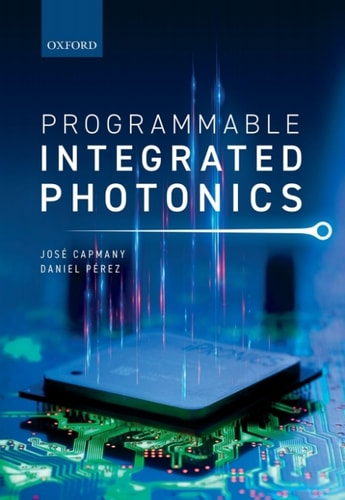
This book provides the first comprehensive, up-to-date and self-contained introduction to the emergent field of Programmable Integrated Photonics (PIP). It covers both theoretical and practical aspects, ranging from basic technologies and the building of photonic component blocks, to design alternatives and principles of complex programmable photonic circuits, their limiting factors, techniques for characterization and performance monitoring/control, and their salient applications both in the classical as well as in the quantum information fields. The book concentrates and focuses mainly on the distinctive features of programmable photonics, as compared to more traditional ASPIC approaches. After some years during which the Application Specific Photonic Integrated Circuit (ASPIC) paradigm completely dominated the field of integrated optics, there has been an increasing interest in PIP. The rising interest in PIP is justified by the surge in a number of emerging applications that call for true flexibility and reconfigurability, as well as low-cost, compact, and low-power consuming devices. Programmable Integrated Photonics is a new paradigm that aims at designing common integrated optical hardware configurations, which by suitable programming, can implement a variety of functionalities. These in turn can be exploited as basic operations in many application fields. Programmability enables, by means of external control signals, both chip reconfiguration for multifunction operation, as well as chip stabilization against non-ideal operations due to fluctuations in environmental conditions and fabrication errors. Programming also allows for the activation of parts of the chip, which are not essential for the implementation of a given functionality, but can be of help in reducing noise levels through the diversion of undesired reflections.
Menrva's Summary
THE THESIS
This book investigates the emerging paradigm of Programmable Integrated Photonics (PIP) as a flexible alternative to traditional Application Specific Photonic Integrated Circuits (ASPIC). The authors, Daniel Pérez and José Capmany, leverage their expertise in integrated optics to provide a comprehensive framework for designing hardware that can be reconfigured through external control signals. The text argues that PIP offers a necessary solution for applications requiring multifunctionality, environmental stabilization, and error correction in photonic systems.
THE SCOPE MAP
What You Will Find
- Theoretical foundations of programmable photonic component blocks
- Design methodologies for complex programmable photonic circuits
- Techniques for characterization and performance monitoring
- Applications in classical and quantum information processing
Scope Limits
- Does not cover legacy ASPIC design methodologies in exhaustive detail
- Excludes non-integrated optical systems or free-space photonics
THE AUTHORITY PERSPECTIVE
Experts identify this work as the foundational text for the field of programmable integrated photonics. Readers frequently note the technical density of the prose, which is intended for researchers and graduate-level engineers.
Page Count:
344
Publication Date:
2020-01-01
Publisher:
OUP Oxford
ISBN-10:
0192582771
ISBN-13:
9780192582775
Science
Power Resources
Alternative & Renewable
Optics
Engineering
Photonics
Technology
Trades & Technology
Integrated Circuits
Community Tags
Similar Books