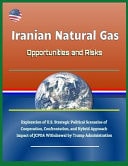
Iranian Natural Gas Opportunities and Risks: Exploration of U.S. Strategic Political Scenarios of Cooperation, Confrontation, and Hybrid Approach, Impact of JCPOA Withdrawal by Trump Administration
0
0
As an Amazon Associate and affiliate partner, Menrva Books earns from qualifying purchases. Learn more
Author Description
This thesis investigates the Islamic Republic of Iran's current natural gas sector and explores the opportunities to monetize its proved natural gas reserves. According to BP statistics, Iran owns the world's second-largest proved natural gas reserves, totaling 33.2 trillion cubic meters, or 17.2% of the world's total proved reserves. Iran's ability to expand its role in the natural gas market depends heavily on its ability to increase production, its capability to reach markets, and improved international relations with the West. The Joint Comprehensive Plan of Action (JCPOA) afforded sanctions relief for Iran to develop and resurrect its battered energy infrastructure with foreign investments. Though the United States withdrew from the JCPOA in May 2018, Iran is expected to increase its natural gas production to at least satisfy growing domestic demands. After analyzing Iran's natural gas capacity, susceptible markets, and infrastructure, this research explores three strategic political scenarios that explore how the United States could approach Iran's natural gas sector: cooperation, confrontation, and a hybrid approach. Iran desires to become a regional energy hub for exports, and U.S. policymakers must pursue a strategy that preserves U.S. interests while also promoting energy security for its allies and partners.The Middle East is one of the wealthiest regions of the world in terms of natural resources, and the potential for Iran to emerge as a major natural gas supplier will inevitably affect geopolitics as natural gas becomes more important for those seeking supplies. The Middle East possesses 41% of the world's natural gas supply - 79.1 trillion cubic meters (TCM) - and Iran controls almost half of that quantity. According to the 2018 BP Statistical Review of World Energy, Iran possesses the world's second-largest proved natural gas reserves totaling 33.2 TCM, approximately 17.2% share of the world's proved reserves. Iran produced 223.9 billion cubic meters
Menrva's Summary
THE THESIS
This thesis investigates the strategic political scenarios for the United States concerning Iran's natural gas sector. Iran possesses the world's second-largest proved natural gas reserves, and its ability to expand its role in the global market is contingent on increasing production, market access, and improved international relations. The withdrawal from the JCPOA by the Trump administration complicates these prospects, yet Iran is expected to prioritize domestic demand. This research analyzes Iran's capacity, markets, and infrastructure to explore three U.S. strategic approaches: cooperation, confrontation, and a hybrid model, aiming to balance U.S. interests with allied energy security.
THE SCOPE MAP
- Analysis of Iran's current natural gas sector and opportunities for monetization of its reserves.
- Examination of Iran's proved natural gas reserves, constituting 17.2% of the world's total.
- Assessment of factors influencing Iran's expansion in the natural gas market: production capacity, market reach, and international relations.
- Impact of the Joint Comprehensive Plan of Action (JCPOA) and the U.S. withdrawal on Iran's energy infrastructure and foreign investment.
- Exploration of three U.S. strategic political scenarios: cooperation, confrontation, and a hybrid approach towards Iran's natural gas sector.
- Consideration of Iran's ambition to become a regional energy hub and the implications for U.S. policymakers.
- Geopolitical impact of Iran's potential emergence as a major natural gas supplier, given the Middle East's significant share of global reserves.
THE AUTHORITY PERSPECTIVE
This work, authored by entities within the U.S. Department of Defense, presents a strategic analysis of Iran's natural gas sector and potential U.S. policy responses. Its focus on geopolitical scenarios and energy security suggests a readership interested in international relations, energy policy, and defense strategy. The research appears to be grounded in statistical data and policy analysis, aiming to inform decision-making regarding U.S. interests and those of its allies in the Middle East.
Page Count:
90
Publication Date:
2018-10-26
Publisher:
Independently Published
ISBN-10:
1729310540
ISBN-13:
9781729310540
Economics
Politics
Non-Fiction
Iran
International relations
Geopolitics
Energy policy
Natural Gas
United States
Community Tags
Similar Books


Reader Comments
Share Your Thoughts
No comments yet. Be the first to share your thoughts!