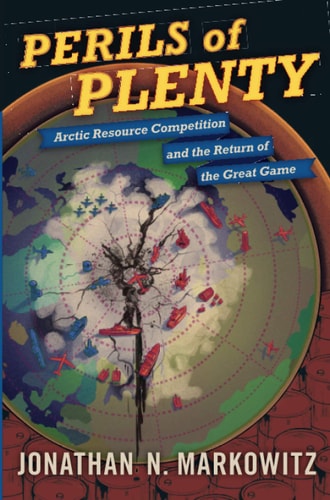
Perils of Plenty: Arctic Resource Competition and the Return of the Great Game: Arctic Resource Competition and the Return of the Great Game
0
0
As an Amazon Associate and affiliate partner, Menrva Books earns from qualifying purchases. Learn more
Author Description
Among scholars who focus on the politics of natural resources, conventional wisdom asserts that resource-scarce states have the strongest interest in securing control over resources. Counterintuitively, however, in Perils of Plenty, Jonathan N. Markowitz finds that the opposite is true. In actuality, what states make influences what they want to take. Specifically, Markowitz argues that the more economically dependent states are on resource extraction rents for income, the stronger their preferences will be to secure control over resources. He tests the theory with a set of case studies that analyze how states reacted to the 2007 exogenous climate shock that exposed energy resources in the Arctic. Given the dangerous potential for conflict escalation in the Middle East and the South China Sea and the continued shrinkage of the polar ice cap, this book speaks to a genuinely important development in world politics that will have implications for understanding the political effects of climate change for many years to come.
Menrva's Summary
THE THESIS
This book investigates the counterintuitive relationship between a state's economic dependence on resource extraction and its propensity to engage in territorial competition over newly accessible Arctic resources. Jonathan N. Markowitz, a scholar of international politics and natural resource management, challenges the conventional wisdom that resource-scarce states are the most aggressive. Instead, he argues that states heavily reliant on resource rents for national income are more likely to pursue aggressive control over energy resources, testing this framework against the geopolitical shifts triggered by the 2007 Arctic climate shock.
THE SCOPE MAP
What You Will Find
- A theoretical framework linking economic rent dependence to territorial expansionism.
- Analysis of state reactions to the 2007 Arctic ice melt and subsequent resource exposure.
- Comparative study of geopolitical tensions in the Arctic, Middle East, and South China Sea.
Scope Limits
- The analysis focuses primarily on state-level economic incentives rather than non-state actor influence.
- The study does not provide a comprehensive forecast of future climate-driven migration patterns.
THE AUTHORITY PERSPECTIVE
Experts in international relations recognize this work as a significant contribution to the study of climate-induced geopolitical conflict. Readers frequently note the academic rigor of the author's argument and the clarity with which he applies economic theory to contemporary environmental challenges.
Page Count:
320
Publication Date:
2020-04-30
Publisher:
Oxford University Press
ISBN-10:
0190078251
ISBN-13:
9780190078256
Politics
Politics & Government
Energy policy
Real Estate
Climate Change
Specific Topics
Arctic Studies
New Used & Rental Textbooks
International relations
World politics
Geopolitics
Community Tags
Similar Books