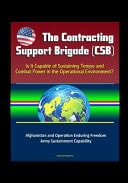
The Contracting Support Brigade (CSB): Is It Capable of Sustaining Tempo and Combat Power in the Operational Environment? Afghanistan and Operation Enduring Freedom, Army Sustainment Capability
0
0
As an Amazon Associate and affiliate partner, Menrva Books earns from qualifying purchases. Learn more
Author Description
The operational commander has the responsibility to link tactical actions in time, space, and purpose to achieve the policy-maker's strategic objectives. Combat power and operational initiative sustained by tempo set the conditions for the decisive action that explicates these tactics. However, these tasks require a capable sustainment architecture that is flexible, responsive, and adaptive to not keep pace with, but instead to facilitate the warfighter's pursuit of the initiative. The costs and build-up required for operational logistics may not align with the temporal and spatial constraints of the mission. In the phase 0 and fiscally constrained operational environment, the Contracting Support Brigade (CSB) can spearhead the operations required to conduct theater-opening, establish initial capability, and posture the warfighter for decisive action. Thus, the operational commander must understand the capabilities and limitations of the CSB. This monograph explains and contrasts both variables and argues that the CSB must expand immediately to meet doctrinal expectations. This expansion of capability will ensure the CSB adequately supports the operational commander in the generation of combat power, sustainment of tempo, and maximization of operational reach. The US Government Accountability Office (GAO), other government agencies, and individual military service components have identified consistent and systemic challenges to maximizing the performance and efficiency of government contracting. However, the US Army as the land proponent for Unified Action (UA) retains robust, but specified sustainment responsibility for Army and joint forces. Thus, the unique, but un-isolated challenges that the Army contracting community must overcome to execute OCS in the future operational environment punctuate the significance of this study. This monograph centers on the Army CSB's capability to support the CENTCOM area of responsibility (AOR), specifically, OEF-A. The CSB, ser
Menrva's Summary
THE THESIS
This monograph investigates the capability of the Contracting Support Brigade (CSB) to sustain tempo and combat power within the operational environment, specifically examining its role in Afghanistan during Operation Enduring Freedom. The study addresses the critical need for a flexible, responsive, and adaptive sustainment architecture that facilitates, rather than merely keeps pace with, warfighter initiative. It explores the potential misalignment between the costs and build-up required for operational logistics and the temporal/spatial constraints of missions, particularly in Phase 0 and fiscally constrained environments. The research argues that the CSB can spearhead theater-opening operations and establish initial capabilities, but its expansion is necessary to meet doctrinal expectations and adequately support operational commanders in generating combat power, sustaining tempo, and maximizing operational reach.
THE SCOPE MAP
- Analysis of the Contracting Support Brigade's (CSB) role in sustaining tempo and combat power.
- Examination of the operational environment in Afghanistan during Operation Enduring Freedom (OEF-A).
- Assessment of the CSB's capability to support the CENTCOM area of responsibility.
- Discussion of the challenges in maximizing the performance and efficiency of government contracting.
- Exploration of the US Army's sustainment responsibilities for Army and joint forces.
- Argument for the expansion of CSB capabilities to meet doctrinal expectations.
- Contrast of the CSB's capabilities and limitations for operational commanders.
THE AUTHORITY PERSPECTIVE
This study, originating from the Department of Defense, offers a focused analysis of the Contracting Support Brigade's effectiveness in a specific operational context. The monograph aims to inform operational commanders about the CSB's strengths and weaknesses, advocating for its expansion to better align with military doctrine and operational demands. It draws upon identified challenges in government contracting and the Army's sustainment responsibilities to underscore the significance of its findings for future operational environments.
Page Count:
70
Publication Date:
2017-02-20
Publisher:
Amazon Digital Services LLC - KDP Print US
ISBN-10:
1520654057
ISBN-13:
9781520654058
History
Non-Fiction
Afghanistan
Government Contracting
Military History
Logistics
Community Tags
Similar Books





Reader Comments
Share Your Thoughts
No comments yet. Be the first to share your thoughts!