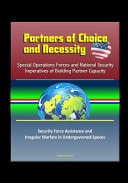
Partners of Choice and Necessity: Special Operations Forces and National Security Imperatives of Building Partner Capacity - Security Force Assistance and Irregular Warfare in Undergoverned Spaces
0
0
As an Amazon Associate and affiliate partner, Menrva Books earns from qualifying purchases. Learn more
Author Description
How do US special operations forces maximize their role in the foreign policy of "building partner capacity" (BPC) to support the objectives of national security strategy? Most analytical writing about partner force development focuses on the wartime advise-and-assist experience of both conventional forces (CF) and special operations forces (SOF). Few scholars have written about the nature of warfare in phase 0 or the strategic utility of special operations campaigns to develop capable and competent forces for partner nations. Fewer still have studied the comprehensive integration of SOF and CF to achieve the policy goals associated with building partner capacity. This monograph identifies gaps in the progression of history, theory, and doctrine for partner force advising and for phase 0 operations in general that contribute to differing cultural attitudes towards these mission and environments between SOF and CF. SOF are proven highly effective in building partner capacity with minimal CF integration, but only when certain criteria are present. When environments are suboptimal, there is insufficient evidence to suggest how these forces might campaign together to complement each other's capabilities and build partner capacity more effectively. US national security policy states that countering the global terrorist network which threatens US and allied interests requires support via an indirect approach through and with the military capacity of our partner nations. Threat groups based in weak and failed states uniformly exploit the undergoverned spaces where US partner nations lack the capacity to deny those spaces to the terrorist or insurgent. US security policy ends therefore include both defeating the terrorist network and supporting partner nation stability. The policy of building partner capacity is the way to achieve those ends, through whole-of-government actions to improve the security, development, and governance abilities of the partner nation. All service
Menrva's Summary
THE THESIS
This monograph investigates how U.S. Special Operations Forces (SOF) can most effectively build partner capacity to support national security objectives, particularly in undergoverned spaces. It examines the historical, theoretical, and doctrinal gaps in advising partner forces and conducting Phase 0 operations, highlighting cultural differences between SOF and conventional forces (CF). The work asserts that while SOF are effective in building partner capacity under certain criteria, there is insufficient evidence on how SOF and CF can campaign together to enhance these efforts when environments are suboptimal. The core argument is that building partner capacity is essential for countering global terrorist networks and supporting partner nation stability by improving their security, development, and governance abilities.
THE SCOPE MAP
- Analysis of U.S. Special Operations Forces (SOF) role in building partner capacity (BPC).
- Examination of Phase 0 operations and strategic utility of SOF campaigns for developing partner nations' forces.
- Study of the integration of SOF and Conventional Forces (CF) to achieve BPC policy goals.
- Identification of historical, theoretical, and doctrinal gaps in partner force advising and Phase 0 operations.
- Exploration of differing cultural attitudes towards these missions between SOF and CF.
- Assessment of SOF effectiveness in BPC with minimal CF integration under specific criteria.
- Discussion on how SOF and CF might campaign together in suboptimal environments to build partner capacity.
- Focus on countering terrorist networks in undergoverned spaces through partner nation military capacity.
THE AUTHORITY PERSPECTIVE
This work is a U.S. Government monograph from the Department of Defense, indicating it is an official analysis of military strategy and policy. The content focuses on the operational and strategic challenges of building partner capacity, suggesting it is intended for military professionals, policymakers, and academics specializing in national security and international relations. The detailed examination of SOF and CF integration, along with the focus on undergoverned spaces, points to a readership interested in the practical application of security force assistance and counter-terrorism strategies.
Page Count:
88
Publication Date:
2017-02-27
Publisher:
Amazon Digital Services LLC - KDP Print US
ISBN-10:
1520711689
ISBN-13:
9781520711683
Non-Fiction
Politics
History
Security Studies
Government Policy
Military Science
International relations
Community Tags
Similar Books




Reader Comments
Share Your Thoughts
No comments yet. Be the first to share your thoughts!