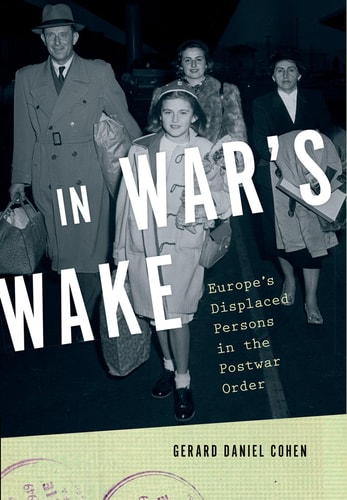
In War's Wake: Europe's Displaced Persons in the Postwar Order
0
0
As an Amazon Associate and affiliate partner, Menrva Books earns from qualifying purchases. Learn more
Author Description
The end of the Second World War in Europe gave way to a gigantic refugee crisis. Thoroughly prepared by Allied military planners, the swift repatriation of millions of former forced laborers, concentration camp inmates and prisoners of war nearly brought this dramatic episode top a close. Yet in September 1945, the number of displaced persons placed under the guardianship of Allied armies and relief agencies in occupied Germany amounted to 1.5 million. A costly burden for the occupying powers, the Jewish, Polish, Ukrainian, Yugoslav and Baltic DPs unwilling to return to their countries of origin presented a complex international problem. Massed in refugee camps stretched from Northern Germany to Sicily, the DPs had become long-term asylum seekers.Based on the records of the International Refugee Organization, this book describes how the European DP crisis impinged on the shape of the postwar order. The DP question directly affected the outbreak of the Cold War; the transformation of the "West" into a new geopolitical entity; the conduct of political purges and retribution; the ideology and methods of modern humanitarian interventions; the appearance of international agencies and non-governmental organizations; the emergence of an international human rights system; the organization of migration movements and the redistribution of "surplus populations"; the advent of Jewish nationhood; and postwar categorizations of political and humanitarian refugees.
Menrva's Summary
THE THESIS
This work investigates how the massive displacement of populations in post-World War II Europe fundamentally shaped the development of the modern international order. Gerard Daniel Cohen, a historian specializing in international relations, utilizes archival records from the International Refugee Organization to analyze the intersection of humanitarian crisis and geopolitical strategy. He argues that the management of displaced persons was not merely a logistical challenge but a catalyst for the emergence of modern human rights systems, international agencies, and the geopolitical configuration of the Cold War era.
THE SCOPE MAP
What You Will Find
- Analysis of the International Refugee Organization records and Allied occupation policies.
- Examination of the transition from wartime repatriation efforts to long-term asylum management.
- Exploration of the links between refugee crises and the formation of the Western geopolitical bloc.
- Discussion on the evolution of humanitarian intervention and international migration policies.
Scope Limits
- The study focuses primarily on the European theater and does not provide an exhaustive account of global refugee movements outside the immediate postwar Western sphere.
THE AUTHORITY PERSPECTIVE
Scholars and historians recognize this text as a significant contribution to the study of postwar reconstruction and the institutionalization of human rights. Readers frequently note the academic density of the prose, which provides a rigorous examination of how humanitarian crises influence statecraft and international law.
Page Count:
250
Publication Date:
2017-08-15
Publisher:
Oxford University Press
ISBN-10:
0190840803
ISBN-13:
9780190840808
History
International relations
Military History
Government Policy
Europe emigration and immigration
Modern History
European History
Jewish History
Community Tags
Similar Books