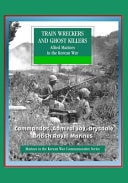
Marines in the Korean War Commemorative Series: Train Wreckers and Ghost Killers - Allied Marines in the Korean War, Commandos, Admiral Joy, Drysdale, British Royal Marines
0
0
As an Amazon Associate and affiliate partner, Menrva Books earns from qualifying purchases. Learn more
Author Description
In the early morning hours of 25 June 1950, mechanized and ground units of the North Korean Peoples' Army (NKPA) rolled across the 38th Parallel into the neighboring Republic of Korea (ROK). Within 48 hours, President Harry S. Truman placed U.S. forces in Japan on alert. Within a week's time, elements of the U.S. Eighth Army, then on occupation duty in Japan, were rushed to South Korea to stem the North Korean invasion. As army soldiers, and later Marines of Brigadier General Edward A. Craig's 1st Provisional Marine Brigade, fought the NKPA to the outskirts of the port of Pusan, the United Nations undertook a series of votes that not only condemned the North Korean invasion, but brought thousands of allied troops to the assistance of the beleaguered ROK. Among the troops assigned to the Korean theater was a hastily assembled unit of Royal Marines stationed in Great Britain and Malaya, where they were already engaged in a guerrilla war against Communist terrorists. The deployment of Royal Marines to Korea came as the government of Prime Minister Clement R. Attlee announced its intention in the British Parliament to add to the forces being sent to Korea. While there was some disagreement with this decision among the Chief of the Imperial General Staff, Field Marshal Viscount William Slim, and Chief of the Air Staff, Marshal Arthur W. Tedder, both of whom argued that "Britain was already engaged in active operations in Malaya as important... in countering communist expansion as in Korea," Admiral Lord Fraser of North Cape, the First Sea Lord, strenuously advocated for the dispatch of a brigade-sized force of Royal Marines to operate in unison with the U.S. Navy as a commando raiding force. Within two weeks of Lord Fraser's decision, on 16 August 1950, a 300-man Royal Marine unit was formed and took the name 41 Independent Commando. "Independent" in the unit designation meant the commanding officer had sole responsibility for the unit and did not have to consult higher
Menrva's Summary
THE THESIS
The Korean War erupted with a surprise invasion, prompting a swift international response and the deployment of specialized Allied forces. The narrative details the initial North Korean invasion of South Korea in June 1950, the subsequent U.S. military response, and the crucial involvement of the United Nations. It specifically highlights the formation and deployment of the British 41 Independent Commando, Royal Marines, detailing their origins in counter-insurgency operations in Malaya and their advocacy for inclusion in the Korean theater by Admiral Lord Fraser.
THE SCOPE MAP
- The context of the North Korean invasion of South Korea in June 1950.
- The initial U.S. military response and the deployment of the 1st Provisional Marine Brigade.
- The formation and mission of the British 41 Independent Commando, Royal Marines.
- The role of Admiral Lord Fraser in advocating for the Royal Marines' deployment.
- The operational background of the Royal Marines in Malaya.
- The command structure and autonomy of the 'Independent' commando unit.
THE AUTHORITY PERSPECTIVE
This historical account focuses on the critical early stages of the Korean War and the specific contributions of Allied commando units, particularly the British Royal Marines. The detailed narrative suggests a work aimed at military history enthusiasts and those interested in the operational aspects of the conflict. The emphasis on the formation and advocacy for 41 Independent Commando indicates a deep dive into the strategic and logistical considerations behind deploying specialized forces.
Page Count:
107
Publication Date:
2017-05-08
Publisher:
Amazon Digital Services LLC - KDP Print US
ISBN-10:
1521250294
ISBN-13:
9781521250297
Non-Fiction
History
Korean War
Military History
Community Tags
Similar Books




Reader Comments
Share Your Thoughts
No comments yet. Be the first to share your thoughts!