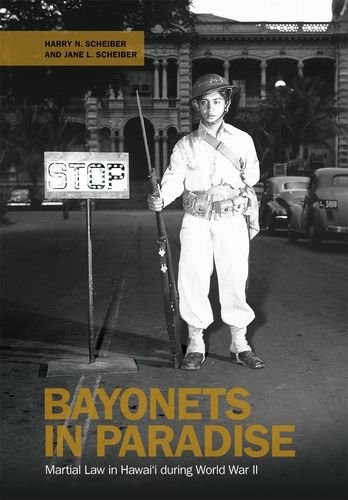
Bayonets in Paradise
0
0
As an Amazon Associate and affiliate partner, Menrva Books earns from qualifying purchases. Learn more
Author Description
Bayonets in Paradise recounts the extraordinary story of how the army imposed rigid and absolute control on the total population of Hawaiʻi during World War II. Declared immediately after the Pearl Harbor attack, martial law was all-inclusive, bringing under army rule every aspect of the Territory of Hawaiʻi's laws and government institutions. Even the judiciary was placed under direct subservience to the military authorities. The result was a protracted crisis in civil liberties, as the army subjected more than 400,000 civilians--citizens and alien residents alike--to sweeping, intrusive social and economic regulations and to enforcement of army orders in provost courts with no semblance of due process. In addition, the army enforced special regulations against Hawaiʻi's large population of Japanese ancestry; thousands of Japanese Americans were investigated, hundreds were arrested, and some 2,000 were incarcerated.^ In marked contrast to the well-known policy of the mass removals on the West Coast, however, Hawaiʻi's policy was one of "selective," albeit preventive, detention. Army rule in Hawaiʻi lasted until late 1944--making it the longest period in which an American civilian population has ever been governed under martial law. The army brass invoked the imperatives of security and "military necessity" to perpetuate its regime of censorship, curfews, forced work assignments, and arbitrary "justice" in the military courts. Broadly accepted at first, these policies led in time to dramatic clashes over the wisdom and constitutionality of martial law, involving the president, his top cabinet officials, and the military. The authors also provide a rich analysis of the legal challenges to martial law that culminated in Duncan v. Kahanamoku, a remarkable case in which the U.S.^ Supreme Court finally heard argument on the martial law regime--and ruled in 1946 that provost court justice and the military's usurpation of the civilian government had been illegal. Based l
Menrva's Summary
THE THESIS
The imposition of martial law in Hawaiʻi following the Pearl Harbor attack led to an unprecedented crisis in civil liberties, with the army exercising absolute control over the civilian population for an extended period. The army declared martial law immediately after the attack on Pearl Harbor, bringing all aspects of Hawaiʻi's laws and government institutions under military rule, including the judiciary. This resulted in the subjugation of over 400,000 civilians to intrusive regulations and arbitrary justice in provost courts, with particular emphasis on the Japanese American population, leading to investigations, arrests, and incarceration. The army invoked security and military necessity to justify censorship, curfews, forced labor, and a lack of due process, sparking significant legal challenges that ultimately reached the Supreme Court.
THE SCOPE MAP
- The imposition of martial law in Hawaiʻi following the Pearl Harbor attack.
- The army's absolute control over the Territory of Hawaiʻi's laws and government institutions.
- The crisis in civil liberties and the impact on over 400,000 civilians.
- Special regulations and detentions targeting the Japanese American population.
- The legal challenges to martial law, culminating in Duncan v. Kahanamoku.
- The U.S. Supreme Court's ruling on the illegality of provost court justice and military usurpation of civilian government.
THE AUTHORITY PERSPECTIVE
This historical account meticulously details the extensive and prolonged period of martial law in Hawaiʻi during World War II, examining its profound impact on civil liberties. The book analyzes the legal justifications invoked by the military, such as security and necessity, against the backdrop of significant infringements on due process and individual freedoms. It highlights the contrast with West Coast policies and the eventual landmark Supreme Court case, Duncan v. Kahanamoku, which declared the military's actions illegal. The work provides a comprehensive look at a critical, yet often overlooked, chapter of American history during wartime.
Page Count:
512
Publication Date:
2016-01-01
ISBN-10:
0824852885
ISBN-13:
9780824852887
Non-Fiction
History
Art
Law
Community Tags
Similar Books