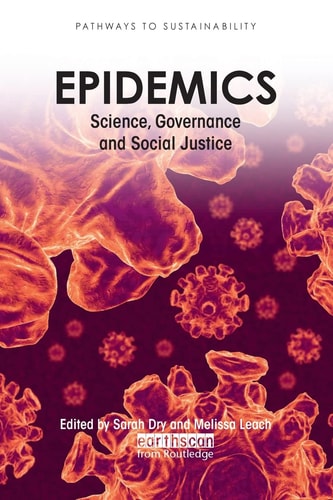
Epidemics: Science, Governance, and Social Justice
0
0
As an Amazon Associate and affiliate partner, Menrva Books earns from qualifying purchases. Learn more
Author Description
Recent disease events such as SARS, H1N1 and avian influenza, and haemorrhagic fevers have focussed policy and public concern as never before on epidemics and so-called 'emerging infectious diseases'. Understanding and responding to these often unpredictable events have become major challenges for local, national and international bodies. All too often, responses can become restricted by implicit assumptions about who or what is to blame that may not capture the dynamics and uncertainties at play in the multi-scale interactions of people, animals and microbes. As a result, policies intended to forestall epidemics may fail, and may even further threaten health, livelihoods and human rights. The book takes a unique approach by focusing on how different policy-makers, scientists, and local populations construct alternative narratives-accounts of the causes and appropriate responses to outbreaks- about epidemics at the global, national and local level. The contrast between emergency-oriented, top-down responses to what are perceived as potentially global outbreaks and longer-term approaches to diseases, such as AIDS, which may now be considered endemic, is highlighted. Case studies-on avian influenza, SARS, obesity, H1N1 influenza, HIV/AIDS, tuberculosis, and haemorrhagic fevers-cover a broad historical, geographical and biological range. As this book explores, it is often the most vulnerable members of a population-the poor, the social excluded and the already ill-who are likely to suffer most from epidemic diseases. At the same time, they may be less likely to benefit from responses that may be designed from a global perspective that neglects social, ecological and political conditions on the ground. This book aims to bring the focus back to these marginal populations to reveal the often unintended consequences of current policy responses to epidemics. Important implications emerge - for how epidemics are thought about and represented; for how surveillance and resp
Menrva's Summary
THE THESIS
This book investigates how societal structures and differing narratives influence our understanding and response to epidemics, often to the detriment of vulnerable populations. The authors, drawing on their expertise, examine the construction of epidemic narratives by policymakers, scientists, and local communities, highlighting the disconnect between global perspectives and on-the-ground realities. They explore how implicit assumptions about blame can lead to ineffective or even harmful policies, particularly for marginalized groups. The book contrasts emergency responses to potential global outbreaks with long-term approaches to endemic diseases, using diverse case studies to illustrate these dynamics.
THE SCOPE MAP
- Analysis of recent epidemics including SARS, H1N1, avian influenza, and haemorrhagic fevers.
- Exploration of the multi-scale interactions of people, animals, and microbes in disease transmission.
- Examination of how policymakers, scientists, and local populations construct competing narratives about epidemics.
- Contrast between top-down, emergency responses and long-term approaches to endemic diseases like HIV/AIDS.
- Case studies on avian influenza, SARS, obesity, H1N1 influenza, HIV/AIDS, tuberculosis, and haemorrhagic fevers.
- Focus on the disproportionate impact of epidemics on vulnerable populations (the poor, socially excluded, already ill).
- Critique of global policy responses that neglect local social, ecological, and political conditions.
- Implications for how epidemics are conceptualized, represented, and managed through surveillance and response.
THE AUTHORITY PERSPECTIVE
The book is recognized for its unique, interdisciplinary approach to understanding epidemics, bridging scientific, policy, and social justice perspectives. It is noted for its critical examination of how responses to outbreaks can inadvertently harm vulnerable populations, challenging conventional top-down strategies. The inclusion of diverse case studies across historical, geographical, and biological ranges provides a comprehensive view of epidemic dynamics. The work is valued for bringing the focus back to marginalized communities and the unintended consequences of current public health policies.
Page Count:
299
Publication Date:
2010-01-01
Publisher:
Routledge
ISBN-10:
184971102X
ISBN-13:
9781849711029
Non-Fiction
Science
Politics
Medical Anthropology
Policy
Epidemiology
Public Health
Global Health
Social justice
Community Tags
Similar Books