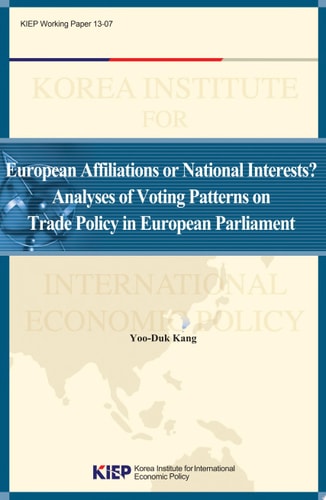
European Affiliations or National Interests: Analyses of Voting Patterns on Trade Policy in the European Parliament
0
0
As an Amazon Associate and affiliate partner, Menrva Books earns from qualifying purchases. Learn more
Author Description
This paper reviews changes in role of European Parliament (EP) in EU’s trade policy since the Lisbon Treaty. The Treaty brought about important changes in EU governance, and in particular, strengthening of the role of the EP. EP’s competences in trade policy were also strengthened. All trade agreements with third countries require a consent from the EP in the ratification procedure and all trade-related legislations must be jointly decided by the Council and the EP. This paper examines the determinants of voting patterns for EU’s trade legislations including EU’s Free Trade Agreements (FTA) with Korea and Colombia/Peru. The results confirm that Members of European Parliaments (MEP) still tend to vote with others in their political groups in trade legislations and their voting pattern is not very different from the previous pattern. This trend is confirmed by both the comparison of intra-voting cohesion index and the empirical test based on the probit model. Country-specific variables do not explain well the voting behavior of MEPs. However, it is noteworthy that some MEPs voted in line with their national interests in case of Korea-EU FTA. It is expected that influences of the EP on EU’s trade policy would increase over time, as MEPs realize their new powers and learn how to use it to reflect their opinion on EU’s trade agenda. As the EU expands its FTAs to the United States and Japan, much larger trade partner than the EU ever negotiated, more active involvements from the EP are expected. This means that various interest groups, such as trade associations and NGOs will attempt to exert greater influence on the European Parliament as well as the European Commission. I. Introduction II. Role of European Parliament in the EU’s Trade Policy 1. EU’s Trade Policy and the EP’s Involvement 2. Changes in EP’s Competences after the Lisbon Treaty III. Literature Review of Voting Patterns of European Parliame
Menrva's Summary
THE THESIS
This paper investigates the evolving influence of the European Parliament on EU trade policy following the Lisbon Treaty. It examines the voting patterns of Members of the European Parliament (MEPs) on trade legislation, specifically analyzing the EU's Free Trade Agreements with Korea and Colombia/Peru, and explores the determinants of these voting behaviors, considering both political group cohesion and national interests.
THE SCOPE MAP
- Analysis of the European Parliament's role in EU trade policy post-Lisbon Treaty.
- Examination of strengthened EP competences in trade policy, including consent for trade agreements and co-decision on trade legislation.
- Investigation into the determinants of MEP voting patterns on trade legislations.
- Case studies of the EU's Free Trade Agreements with Korea and Colombia/Peru.
- Comparison of intra-voting cohesion indices among political groups.
- Empirical testing using a probit model to explain voting behavior.
- Assessment of the influence of national interests versus political group affiliation.
- Discussion on the expected increase in EP influence on future EU trade policy and external trade partners.
THE AUTHORITY PERSPECTIVE
The analysis presented in this paper suggests that while MEPs largely maintain voting cohesion within their political groups on trade legislation, there are instances where national interests, such as in the case of the Korea-EU FTA, can influence voting behavior. The study anticipates a growing role for the European Parliament in shaping EU trade policy as its members become more aware of and adept at utilizing their enhanced powers. This trend is expected to intensify as the EU engages in larger trade negotiations, potentially increasing the influence of various interest groups on both the Parliament and the Commission.
Page Count:
60
Publication Date:
2013-12-31
ISBN-10:
8932242410
ISBN-13:
9788932242415
Non-Fiction
Politics
Economics
European Union
Trade Policy
Community Tags
Similar Books










Reader Comments
Share Your Thoughts
No comments yet. Be the first to share your thoughts!