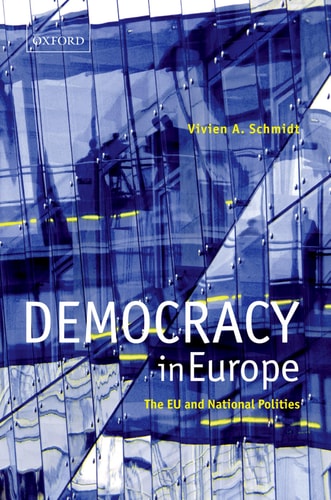
Democracy in Europe: The EU and National Polities
0
0
As an Amazon Associate and affiliate partner, Menrva Books earns from qualifying purchases. Learn more
Author Description
Democracy in Europe is about the impact of European integration on national democracies. It argues that the oft-cited democratic deficit is indeed a problem, but not so much at the level of the European Union per se as at the national level. This is because national leaders and publics have yet to come to terms with the institutional impact of the EU on the traditional workings of their national democracies. The book begins with a discussion of what the EU is-a new form of 'regional state' in which sovereignty is shared, boundaries are variable, identity composite, and democracy fragmented. It then goes on to examine the effects of this on EU member-states' institutions and ideas about democracy, finding that institutional 'fit' matters. The 'compound' EU, in which governing activity is highly dispersed among multiple authorities, is more disruptive to 'simple' polities like Britain and France, where governing activity has traditionally been more concentrated in a single authority, than to similarly 'compound' polities like Germany and Italy. But the book concludes that the real problem for member-states is not so much that their practices have changed as that national ideas and discourse about democracy have not. The failure has been one of the 'communicative' discourse to the general public-which again has been more pronounced for simple polities, despite their potentially greater capacity to communicate through a single voice, than for compound polities, where the 'coordinative' discourse among policy actors predominates.
Menrva's Summary
THE THESIS
This book investigates how European integration has fundamentally altered the functionality and perception of democracy within individual member-state national polities. Vivien A. Schmidt, a scholar of European political economy, utilizes institutional analysis to argue that the perceived democratic deficit is primarily a national-level failure rather than an inherent flaw of the European Union. She posits that the disconnect arises because national political discourse has failed to adapt to the reality of the EU as a 'regional state' characterized by shared sovereignty and fragmented authority.
THE SCOPE MAP
What You Will Find
- Comparative analysis of 'simple' versus 'compound' polities.
- Theoretical framework defining the EU as a regional state.
- Examination of institutional 'fit' and its impact on national governance.
- Analysis of communicative versus coordinative political discourse.
Scope Limits
- Does not provide a comprehensive history of EU treaties or legal developments.
- Focuses primarily on the institutional and discursive impact on member-states rather than the internal administrative mechanics of EU institutions.
THE AUTHORITY PERSPECTIVE
Scholars and political analysts frequently cite this work as a foundational text for understanding the intersection of national sovereignty and supranational integration. Readers often note the academic density of the prose, which is tailored for students and researchers of European politics.
Page Count:
328
Publication Date:
2006-01-01
Publisher:
Oxford University Press
ISBN-10:
0191532967
ISBN-13:
9780191532962
Politics
Comparative Politics
European Union
International relations
Government
Public Policy
Democracy
Community Tags
Other Editions(3)

Similar Books