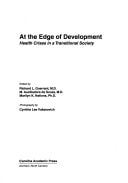
At the Edge of Development: Health Crises in a Transitional Society
0
0
As an Amazon Associate and affiliate partner, Menrva Books earns from qualifying purchases. Learn more
Author Description
Based on the firsthand experiences of a diverse team of physicians, anthropologists, nutritionists, epidemiologists, physiologists and parasitologists, all working over the last fifteen years in the research laboratory and in the field in both rural and urban impoverished communities in Brazil's vibrant but disparately poor Northeast, the authors of this book synthesize an approach to solving the health crises that challenge us to harness technological advances for the benefit of mankind. They point out the necessity of addressing the health crises of the disadvantaged as the only effective means of controlling the population explosion without violating fundamental human rights. They note the unique opportunities that a focus on health provides for addressing the key issues of development that transcend geographic and ideologic boundaries. This book will appeal to a wide range of readers concerned with health in developing areas throughout the world. The anthropologist will learn about public health and epidemiology of tropical infectious diseases; the health professional and medical researcher will learn the importance of working in a culturally sensitive manner with existing practitioners and perceptions; and the economist will learn the issues that are key to health in 80 percent of the world's rapidly growing population who lived in the tropical, developing world. The health crises at the edge of development in Brazil's Northeast hold profound lessons for both developed and developing countries as we convulse into the 21st century, trying to bridge technology with a genuine improvement in the human condition around the world.
Menrva's Summary
THE THESIS
This book investigates the complex health crises at the periphery of development in Brazil's Northeast and proposes a synthesized approach to their resolution. Drawing on fifteen years of firsthand experience from a multidisciplinary team working in impoverished rural and urban communities, the authors present a framework for addressing health challenges by integrating technological advancements with humanistic considerations. They argue that confronting the health crises of disadvantaged populations is essential for controlling population growth without infringing on human rights, highlighting the unique opportunities health initiatives offer for advancing development across diverse geographical and ideological divides.
THE SCOPE MAP
- Analysis of health crises in transitional societies, using Brazil's Northeast as a case study.
- Integration of technological advances with humanitarian approaches to public health.
- Examination of the link between health, population control, and human rights.
- Insights into development issues that transcend geographic and ideological boundaries.
- Perspectives for anthropologists on public health and epidemiology of tropical infectious diseases.
- Guidance for health professionals on culturally sensitive practice.
- Economic considerations for health in developing tropical regions.
THE AUTHORITY PERSPECTIVE
This book is positioned as a vital resource for a broad readership concerned with global health and development. It aims to bridge the gap between technological progress and genuine improvements in the human condition, offering lessons applicable to both developed and developing nations. The interdisciplinary approach, combining medical, anthropological, and economic perspectives, suggests a comprehensive examination of health issues in transitional societies. The work is framed to provide profound insights into the challenges and opportunities present at the edge of development.
Page Count:
449
Publication Date:
1996-01-01
Publisher:
Carolina Academic Pr
ISBN-10:
0890897883
ISBN-13:
9780890897881
Science & Technology
Non-Fiction
Health
Public Health
Brazil
Anthropology
Epidemiology
Community Tags
Similar Books