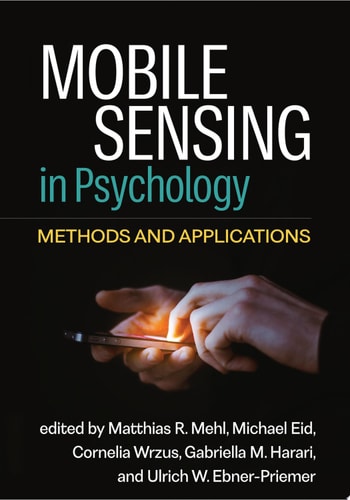
Mobile Sensing in Psychology
0
0
As an Amazon Associate and affiliate partner, Menrva Books earns from qualifying purchases. Learn more
Author Description
The possibilities mobile sensing opens up for the social, behavioral, biomedical, and life sciences appear almost infinite and are bound to become even more comprehensive in the years to come. However, data collection with new information technology also poses new challenges for research and applied fields. Is everything that is possible also legally allowed? What are the personal and societal consequences of the possible deep insights into very private areas of life for research ethics and the relations between the researchers and those being researched? How can data be stored so that anonymity and privacy are preserved? How can quality criteria be formulated for this new and rapidly developing field of research? And how can we ensure that information and predictions derived from mobile sensing are psychometrically accurate and practically useful as we move from scientific proof-of-concept measurements to medical/clinical measurements that aim at supporting and improving the diagnostic process? This handbook answers these questions and based on the conviction that a profound understanding and the sound application of mobile sensing methods require specific knowledge and competencies: scientific background and the key concepts, how to generally plan and conduct a mobile sensing study, different methods of data collection with mobile sensing, both in terms of the technological know-how and the methodological how-to, and possibilities and limitations of mobile sensing and of best-practice examples from different areas of application
Menrva's Summary
THE THESIS
This handbook addresses the complex ethical, methodological, and practical challenges of mobile sensing in psychological research. It explores the vast potential of mobile sensing across various scientific disciplines while confronting the critical questions surrounding data collection, privacy, anonymity, and research ethics. The authors, leading experts in the field, aim to equip researchers with the necessary knowledge and competencies to navigate this rapidly evolving landscape.
THE SCOPE MAP
- Foundational scientific background and key concepts of mobile sensing.
- Guidance on planning and conducting mobile sensing studies.
- Detailed exploration of different data collection methods, including technological and methodological aspects.
- Discussion of the possibilities and limitations of mobile sensing.
- Best-practice examples from diverse application areas.
- Considerations for research ethics, anonymity, and privacy preservation.
- Insights into ensuring psychometric accuracy and practical utility of mobile sensing data for diagnostic and clinical applications.
THE AUTHORITY PERSPECTIVE
This handbook is designed to provide a comprehensive overview of mobile sensing for researchers and practitioners in the social, behavioral, biomedical, and life sciences. It tackles crucial questions regarding the ethical and practical implementation of mobile sensing technologies, aiming to foster a deeper understanding and sound application of these methods. The text emphasizes the need for specific knowledge and competencies, covering everything from study design to data analysis and quality criteria. The authority perspective suggests this work is intended for those seeking to move from scientific proof-of-concept measurements to more applied, clinical uses of mobile sensing data.
Page Count:
760
Publication Date:
2023-11-20
Publisher:
Guilford Publications
ISBN-10:
1462553109
ISBN-13:
9781462553105
Science
Non-Fiction
Psychology
Research Methods
Technology
Data Science
Community Tags
Similar Books