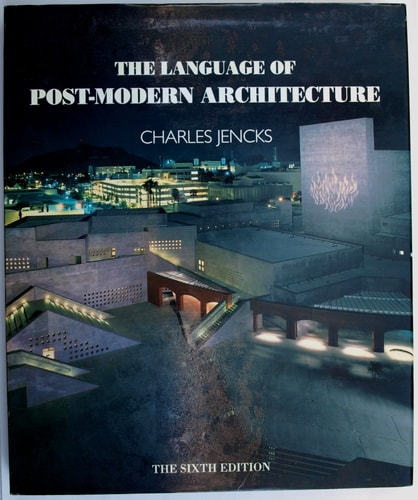
The Language of Post-modern Architecture
0
0
As an Amazon Associate and affiliate partner, Menrva Books earns from qualifying purchases. Learn more
Author Description
"This book, now in its Sixth Edition, has become a classic. Written in 1977, it was the first to define Post-Modernism in architecture, an event which led to subsequent adoption of the term in other fields. Perhaps no other book since Le Corbusier's Towards a New Architecture and Robert Venturi's Complexity and Contradiction in Architecture has had such importance in shaping opinions and practice, and the Sixth Edition brings the story up to date. It is the story of the failure of Modern Architecture to communicate with its users and the attempt of Post-Modernists to overcome the failure with a richer, more widely shared language - Post Modern Classicism. First synthesised by Michael Graves, Arata Isozaki, James Stirling and Hans Hollein, this idiom has spread around the world and is now practised by most major firms. But success has also brought problems, which the Sixth Edition treats. Large-scale, billion-dollar projects, quickly built, result in superficiality the very defect that killed Modernism and for taking on these the movement is rightly criticised. Many Late-Modernists gloated at a few kitsch results and declared the movement dead. But, as Charles Jencks shows, in spite of the commercialism, a leaner, fitter, more subtle tradition has emerged. The movement has evolved in two benign ways: towards the low-scaled 'office as village' evident in Amsterdam, Frankfurt and Tokyo, and towards the 'cultural centre as village', by James Stirling, Kisho Kurokawa and Antoine Predock. This new village planning is more convival than the megastructure of the recent past, and the architectural style more allusive and subtle. The Sixth Edition describes the flirtation of Post-Modernists with the Disney Empire, the enormous buildings in Florida by Michael Graves, and the huge urban schemes in Boston and New York by SOM and Cesar Pelli. These large projects have produce mixed results, and a few clear improvements such as the IBA building programme in Berlin. But it is the s
Page Count:
204
Publication Date:
1991-01-01
Publisher:
Academy Editions
ISBN-10:
0847813592
ISBN-13:
9780847813599
Community Tags
Other Editions(4)

Reader Comments
Share Your Thoughts
No comments yet. Be the first to share your thoughts!