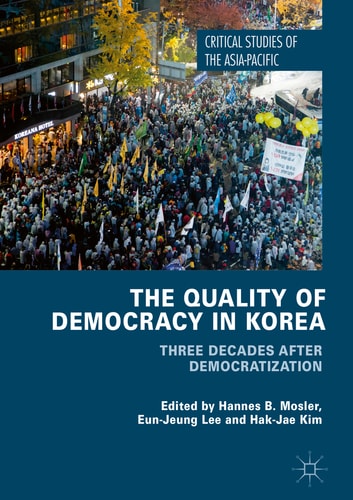
The Quality of Democracy in Korea
0
0
As an Amazon Associate and affiliate partner, Menrva Books earns from qualifying purchases. Learn more
Author Description
This edited volume assesses the quality of democracy in the Republic of Korea three decades after its formal democratization in 1987. It has been argued that Korea’s two subsequent power turnovers prove that its democracy has been successfully consolidated, despite its tremendous progress; however, recent developments show signs of deterioration and retreat. Therefore, drawing on the recent quality of democracy literature this volume sets out to answer the question: Where does Korea’s democratic quality stand today? The three chapters in first section of the book focus on aspects related to the presidency, political parties, and organized labor, also including the perspective of governance and human security as well as on the rule of law regarding the role and function of the prosecution. This is followed by a set of four chapters in section two that address the dimensions of democratic quality such as participation, freedom, equality, and responsiveness. The final, third section includes contributions on related inter-Korean policy issues. This book is an invaluable resource for political and social scientist working on democratic quality, and at the same for scholars in Asian or Korean Studies at faculty level as well as on graduate student level.
Menrva's Summary
THE THESIS
This volume critically examines the current state of democratic quality in the Republic of Korea, three decades after its formal democratization. The book addresses the argument that Korea's democratic consolidation is proven by power turnovers, while acknowledging recent signs of deterioration. Drawing on contemporary literature on democratic quality, it investigates where Korea's democracy stands today by analyzing the presidency, political parties, organized labor, governance, human security, and the rule of law, including the prosecution's role. It further explores dimensions of participation, freedom, equality, and responsiveness, concluding with contributions on inter-Korean policy issues.
THE SCOPE MAP
- Analysis of the presidency and its role in Korean democracy.
- Examination of political parties and their function in the democratic system.
- The role and impact of organized labor on democratic quality.
- Perspectives on governance and human security within the Korean context.
- An in-depth look at the rule of law, specifically the prosecution's function.
- Assessment of democratic quality through participation, freedom, equality, and responsiveness.
- Contributions addressing related inter-Korean policy issues.
THE AUTHORITY PERSPECTIVE
This edited volume is positioned as an invaluable resource for political and social scientists specializing in democratic quality, as well as scholars and graduate students in Asian or Korean Studies. The book's structure, addressing both institutional aspects and core democratic dimensions, suggests a comprehensive approach to evaluating Korea's democratic progress and challenges. Its focus on recent developments and established literature indicates a scholarly engagement with contemporary debates on democratic consolidation and potential backsliding.
Page Count:
327
Publication Date:
2017-11-15
Publisher:
Springer Nature
ISBN-10:
3319639196
ISBN-13:
9783319639192
Politics
History
Non-Fiction
Human security
Democracy
Korean Studies
Governance
Rule Of Law
Community Tags
Similar Books