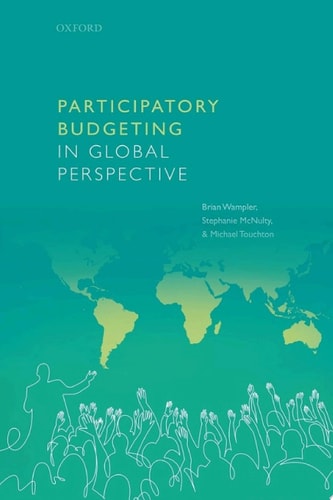
Participatory Budgeting in Global Perspective
0
0
As an Amazon Associate and affiliate partner, Menrva Books earns from qualifying purchases. Learn more
Author Description
Participatory Budgeting continues to spread across the globe as government officials and citizens adopt this innovative democratic program in the hopes of strengthening accountability, civil society, and well-being. Governments often adapt PB's basic program design to meet local needs, thus creating wide variation in how PB programs function. Some programs retain features of radical democracy, others focus on community mobilization, and yet other programs seek to promote participatory development. Participatory Budgeting in Global Perspective provides a theoretical and empirical explanation to account for widespread variation in PB's adoption, adaptation, and impacts. This book develops six "PB types" to account for the wide variation in how PB programs function as well as the outcomes they produce. To illustrate the similar patterns across the globe, four empirical chapters present a rich set of case studies that illuminate the wide differences among these programs; chapters are organized regionally, with chapters on Latin America, Asia, Sub-Saharan Africa, Europe, and North America. By organizing the chapters regionally, it becomes clear that there are temporal, spatial, economic, and organizational factors that produce different programs across regions, but similar programs within each region. A key empirical finding is that the change in PB rules and design is now leading to significant differences in the outcomes these programs produce. We find that some programs successfully promote accountability, expand civil society, and improve well-being but, too often, researchers do not have any evidence tying PB to significant social or political change.
Menrva's Summary
THE THESIS
This book investigates the factors that drive the global variation in the adoption, design, and outcomes of participatory budgeting (PB) programs. The authors, Michael Touchton, Stephanie McNulty, and Brian Wampler, utilize a comparative political science framework to analyze how local governments adapt democratic processes to meet specific regional needs. By synthesizing empirical data from diverse geographic contexts, they propose a typology of six distinct PB models to explain why these programs produce varying levels of accountability and social change.
THE SCOPE MAP
What You Will Find
- A theoretical framework categorizing PB into six distinct operational types.
- Regional case studies covering Latin America, Asia, Sub-Saharan Africa, Europe, and North America.
- Analysis of temporal, spatial, economic, and organizational variables influencing program design.
Scope Limits
- The text does not provide a universal manual for implementing PB in every local jurisdiction.
- It does not offer a definitive causal link between all PB programs and measurable social or political change.
THE AUTHORITY PERSPECTIVE
Experts identify this work as a comprehensive comparative study that clarifies the complexities of democratic innovation in local governance. Readers frequently note the academic density of the prose, which serves as a foundational resource for researchers and policy analysts studying participatory institutions.
Page Count:
256
Publication Date:
2021-01-01
Publisher:
OUP Oxford
ISBN-10:
0192652451
ISBN-13:
9780192652454
Sociology
Democracy
Finance Public
Governance
Comparative Politics
urban planning
Public Policy
Community Tags
Similar Books