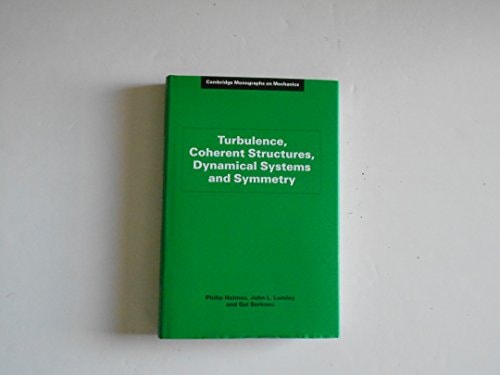
Turbulence, Coherent Structures, Dynamical Systems and Symmetry
0
0
As an Amazon Associate and affiliate partner, Menrva Books earns from qualifying purchases. Learn more
Author Description
For turbulent flows at relatively low speeds there exists an excellent mathematical model in the incompressible Navier-Stokes equations. Why then is the "problem of turbulence" so difficult? One reason is that these nonlinear partial differential equations appear to be insoluble, except through numerical simulations, which offer useful approximations, but little direct understanding. Three recent developments offer new hope. First, the discovery by experimentalists of coherent structures in certain turbulent flows. Secondly, the suggestion that strange attractors and other ideas from finite dimensional dynamical systems theory might play a role in the analysis of the governing equations. And, finally, the introduction of the Karhunen Loève or proper orthogonal decomposition. This book introduces these developments and describes how they may be combined to create low-dimensional models of turbulence, resolving only the coherent structures. This book will interest engineers, especially in the aerospace, chemical, civil, environmental and geophysical areas, as well as physicists and applied mathematicians concerned with turbulence.
Page Count:
420
Publication Date:
1996-10-10
Publisher:
Cambridge University Press
ISBN-10:
0521551420
ISBN-13:
9780521551427