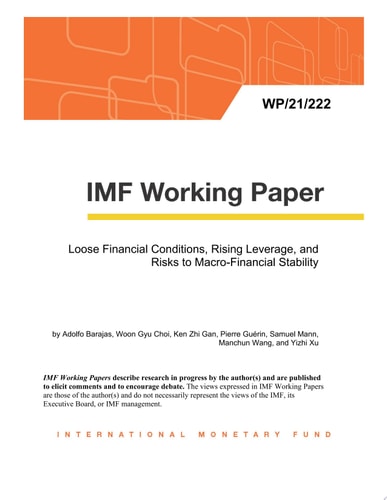
Loose Financial Conditions, Rising Leverage, and Risks to Macro-Financial Stability
0
0
As an Amazon Associate and affiliate partner, Menrva Books earns from qualifying purchases. Learn more
Author Description
After a steady increase following the global financial crisis, private nonfinancial sector leverage rose further during the COVID-19 on the back of easy financial conditions induced by unprecedented policy support. We investigate the empirical relationships between increased leverage, financial conditions, and macro-financial stability in a sample of major advanced and emerging market economies. We find that loose financial conditions contribute to leverage buildups and generate an intertemporal tradeoff: financial stability risk is lessened in the near term but exacerbated in the medium term. The tradeoff is amplified during credit booms, when debt service burdens are particularly high, or when the share of foreign currency debt is high in emerging markets. Selected macroprudential tools can arrest leverage buildups and mitigate the tradeoff.
Menrva's Summary
THE THESIS
Loose financial conditions, rising leverage, and the potential for macro-financial instability are examined in this study. The paper investigates the empirical relationships between increased leverage, financial conditions, and macro-financial stability across major advanced and emerging market economies. It finds that easy financial conditions foster leverage build-ups, creating an intertemporal trade-off where near-term financial stability is improved at the expense of medium-term risks. This trade-off is intensified during credit booms, periods of high debt service burdens, or when foreign currency debt is prevalent in emerging markets.
THE SCOPE MAP
- Analysis of private nonfinancial sector leverage trends post-global financial crisis and during the COVID-19 pandemic.
- Empirical investigation of the links between leverage, financial conditions, and macro-financial stability.
- Identification of an intertemporal trade-off between near-term and medium-term financial stability.
- Factors amplifying the trade-off: credit booms, high debt service burdens, and foreign currency debt share.
- Assessment of selected macroprudential tools for mitigating leverage buildups and financial stability risks.
- Sample includes major advanced and emerging market economies.
THE AUTHORITY PERSPECTIVE
This paper, authored by researchers including Ken Zhi Gan and Adolfo Barajas, analyzes the complex interplay between financial conditions, leverage, and macro-financial stability. The findings suggest a critical trade-off where immediate financial stability gains from loose conditions can lead to greater risks in the medium term. The research highlights specific conditions, such as credit booms and high foreign currency debt, that exacerbate these risks. It also points to the potential efficacy of macroprudential tools in managing these dynamics.
Page Count:
42
Publication Date:
2021-08-20
Publisher:
International Monetary Fund
ISBN-10:
1513591487
ISBN-13:
9781513591483
Economics
Non-Fiction
Finance
Macroeconomics
Community Tags
Similar Books