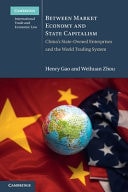
Between Market Economy and State Capitalism: China's State-Owned Enterprises and the World Trading System
0
0
As an Amazon Associate and affiliate partner, Menrva Books earns from qualifying purchases. Learn more
Author Description
One major issue facing the world trading system today is how to deal with the challenge of China's state capitalism. Many commentators believe that the existing WTO rules are insufficient and, thus new rules are needed. This book challenges this conventional wisdom. Through meticulous studies and fresh analysis of the commitments in China's WTO accession package, existing rules on state capitalism in WTO agreements and recent attempts to make new rules on these issues at the bilateral, regional and multilateral levels, this book argues that existing WTO rules, especially those on subsidies, coupled with China-specific rules in its accession protocol, do provide feasible tools to counter China's state capitalism. This book also discusses the reasons for the lack of usage of these rules and provides concrete policy suggestions on how the rules may be better utilized, as well as how to conduct constructive negotiations on new rules in the WTO and beyond.
Menrva's Summary
THE THESIS
This book investigates the adequacy of existing World Trade Organization (WTO) rules in addressing the economic challenges posed by China's state capitalism. It challenges the common belief that new rules are necessary, arguing instead that current WTO agreements, particularly those concerning subsidies and China's specific accession protocol, offer viable mechanisms to counter state-driven economic practices. The analysis explores why these rules have been underutilized and proposes practical strategies for their enhanced application and for future rule-making negotiations.
THE SCOPE MAP
- Analysis of China's WTO accession commitments.
- Examination of existing WTO rules on state capitalism, with a focus on subsidies.
- Discussion of recent rule-making efforts at bilateral, regional, and multilateral levels.
- Identification of reasons for the underutilization of current WTO rules.
- Policy suggestions for better utilization of existing rules.
- Guidance for conducting negotiations on new rules within and beyond the WTO.
THE AUTHORITY PERSPECTIVE
The book challenges conventional wisdom regarding the WTO's capacity to manage China's state capitalism, proposing that existing rules, particularly on subsidies and China's accession protocol, are sufficient. It aims to provide a fresh analysis of these commitments and recent rule-making attempts. The work also seeks to explain the underuse of these tools and offers concrete policy recommendations for their improved application and for future negotiations.
Page Count:
223
Publication Date:
2024-11-14
Publisher:
Cambridge University Press
ISBN-10:
1108828493
ISBN-13:
9781108828499
Non-Fiction
Politics
Economics
International Trade
China Studies
Law
Community Tags
Similar Books