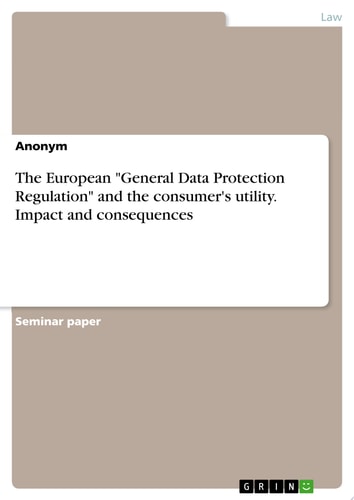
The European "General Data Protection Regulation" and the Consumer's Utility: Impact and Consequences
0
0
As an Amazon Associate and affiliate partner, Menrva Books earns from qualifying purchases. Learn more
Author Description
Seminar paper from the year 2018 in the subject Law - Data protection, grade: 2,0, University of Hohenheim, language: English, abstract: This paper aims to conduct a critical literature review on the main research question: Does the European General Data Protection Regulation increase consumer's utility by increasing privacy protection? The paper is structured as follows in chapter 2.1, a systematic framework of the notion of privacy and privacy protection will be described. Afterwards, the paper will study which kind of personal data is collected, data collection technologies such as user log-in information, cookies or IP address, and the usage process of personal data. Then, in chapter 2.3, the command and control policy is considered a consumer policy instrument to determine how the consumer can benefit from the command and control policy and how the government can set limitations about the level of privacy protection and consumer's welfare. The last chapter 2.4 presents the significant articles of the law European General Data Protection Regulation (EU GDPR) for privacy protection and the consequences for non-compliance with the EU GDPR. In the main part, the research tries to answer the following questions split in chapters 3.1 and 3.2: How can we reduce privacy concerns? Can a privacy protection law like the EU GDPR lower privacy concerns and protect the welfare of the consumer? This paper sets out the main arguments for introducing consumers’ privacy concerns, privacy paradox, and consumer's utility regarding consumer welfare to answer the questions as mentioned above. Finally, the paper will summarise the findings and a concluding solution to the research question. Edward Snowden's disclosures regarding the surveillance practices of the National Security Agency (NSA) and the Facebook-Cambridge Analytica affair, in which data from up to 87 million Facebook users were illegally collected. These both cases were the largest personal data scandal in the past year
Menrva's Summary
THE THESIS
This paper critically reviews the European General Data Protection Regulation (GDPR) to determine if it genuinely enhances consumer utility by strengthening privacy protection. The research examines the definition of privacy and its protection, the types of personal data collected, and how it is used, including technologies like cookies and IP addresses. It analyzes command and control policies as consumer welfare instruments and government limitations on privacy. The paper also details key GDPR articles for privacy protection, consequences of non-compliance, and addresses privacy concerns, the privacy paradox, and consumer utility in relation to consumer welfare, referencing major data scandals like those involving Edward Snowden and Facebook-Cambridge Analytica.
THE SCOPE MAP
- Systematic framework of privacy and privacy protection
- Analysis of personal data collection, technologies (log-ins, cookies, IP addresses), and usage processes
- Examination of command and control policy as a consumer policy instrument
- Identification of key GDPR articles for privacy protection and non-compliance consequences
- Investigation into reducing privacy concerns and the impact of GDPR on consumer welfare
- Discussion of the privacy paradox and consumer utility regarding consumer welfare
- Case studies of major data scandals (NSA surveillance, Facebook-Cambridge Analytica)
THE AUTHORITY PERSPECTIVE
This seminar paper offers a structured analysis of the GDPR's impact on consumer utility and privacy. The research methodology involves a critical literature review, focusing on established legal and economic frameworks. The paper aims to provide a comprehensive overview of the regulation's practical implications, drawing on significant real-world data breaches to contextualize its importance. The findings are intended to contribute to the ongoing discussion about the effectiveness of data protection laws in safeguarding consumer welfare.
Page Count:
25
Publication Date:
2021-05-04
Publisher:
GRIN Verlag
ISBN-10:
3346400549
ISBN-13:
9783346400543
Economics
Politics
Non-Fiction
Law
Data Protection
Consumer Rights
Community Tags
Similar Books







Reader Comments
Share Your Thoughts
No comments yet. Be the first to share your thoughts!