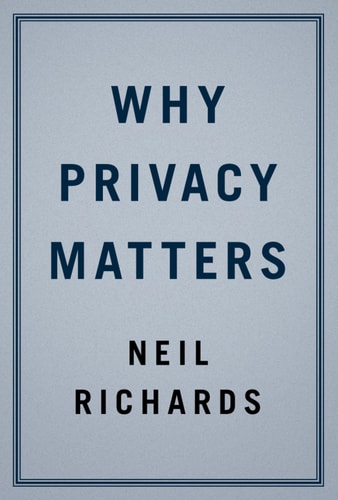
Why Privacy Matters
0
0
As an Amazon Associate and affiliate partner, Menrva Books earns from qualifying purchases. Learn more
Author Description
A much-needed corrective on what privacy is, why it matters, and how we can protect in an age when so many believe that the concept is dead. Everywhere we look, companies and governments are spying on us--seeking information about us and everyone we know. Ad networks monitor our web-surfing to send us "more relevant" ads. The NSA screens our communications for signs of radicalism. Schools track students' emails to stop school shootings. Cameras guard every street corner and traffic light, and drones fly in our skies. Databases of human information are assembled for purposes of "training" artificial intelligence programs designed to predict everything from traffic patterns to the location of undocumented migrants. We're even tracking ourselves, using personal electronics like Apple watches, Fitbits, and other gadgets that have made the "quantified self" a realistic possibility. As Facebook's Mark Zuckerberg once put it, "the Age of Privacy is over." But Zuckerberg and others who say "privacy is dead" are wrong. In Why Privacy Matters, Neil Richards explains that privacy isn't dead, but rather up for grabs. Richards shows how the fight for privacy is a fight for power that will determine what our future will look like, and whether it will remain fair and free. If we want to build a digital society that is consistent with our hard-won commitments to political freedom, individuality, and human flourishing, then we must make a meaningful commitment to privacy. Privacy matters because good privacy rules can promote the essential human values of identity, power, freedom, and trust. If we want to preserve our commitments to these precious yet fragile values, we will need privacy rules. Richards explains why privacy remains so important and offers strategies that can help us protect it from the forces that are working to undermine it. Pithy and forceful, this is essential reading for anyone interested in a topic that sits at the center of so many current problems.
Menrva's Summary
THE THESIS
This book investigates the persistent relevance of privacy in the digital age, arguing that the concept is not obsolete but rather a critical site of power struggle. Neil Richards, a law professor and expert in information privacy, utilizes legal theory and historical analysis to challenge the narrative that privacy is dead. He posits that privacy is a fundamental requirement for maintaining political freedom, individual autonomy, and human flourishing in a society increasingly dominated by surveillance and data collection.
THE SCOPE MAP
What You Will Find
- Analysis of surveillance practices by corporations and government entities
- Examination of the relationship between privacy, power, and democratic values
- Frameworks for understanding privacy as a tool for protecting identity and trust
- Strategies for developing legal and social rules to govern data usage
Scope Limits
- Does not provide a technical manual for individual digital security or encryption tools
- Does not focus on the history of privacy law prior to the digital era
THE AUTHORITY PERSPECTIVE
Experts and legal scholars frequently cite this work as a clear, accessible entry point into the complex intersection of law and digital surveillance. Readers often note that the prose remains grounded and persuasive, making it a standard text for those seeking to understand the policy implications of modern data practices.
Page Count:
293
Publication Date:
2021-01-01
Publisher:
Oxford University Press
ISBN-10:
0190939060
ISBN-13:
9780190939069
Non-Fiction
Law And Legislation
Professional Career & Trade
Sociology
Social Aspects
Data Protection
Digital Rights
Law
Protection Of Privacy
Technology
Privacy
Protection
Consumer protection
Consumer Advocacy
Consommateurs
Community Tags
Other Editions(3)


Similar Books









Reader Comments
Share Your Thoughts
No comments yet. Be the first to share your thoughts!