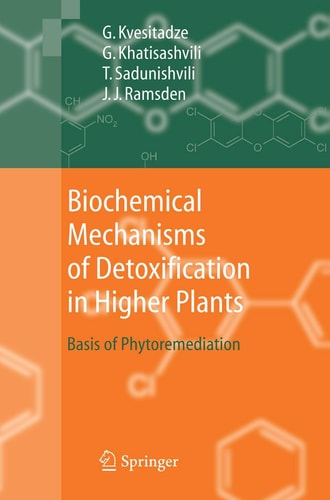
Biochemical Mechanisms of Detoxification in Higher Plants: Basis of Phytoremediation
0
0
As an Amazon Associate and affiliate partner, Menrva Books earns from qualifying purchases. Learn more
Author Description
Plants play a key role in purifying the biosphere of the toxic effects of industrial activity. This book shows how systematic application of the results of investigations into the metabolism of xenobiotics (foreign, often toxic substances) in plants could make a vastly increased contribution to planetary well-being. Deep physiological knowledge gained from an accumulation of experimental data enables the great differences between the detoxifying abilities of different plants for compounds of different chemical nature to be optimally exploited. Hence planting could be far more systematically adapted to actual environmental needs than is actually the case at present. The book could form the basis of specialist courses in universities and polytechnics devoted to environmental management, and advanced courses in plant physiology and biochemistry, for botany and integrative biology students. Fundamental plant physiology and biochemistry from the molecular level to whole plants and ecosystems are interwoven in a powerful and natural way, making this a unique contribution to the field.
Menrva's Summary
THE THESIS
This book investigates the biochemical mechanisms by which higher plants detoxify xenobiotics, exploring their potential for phytoremediation. It details how understanding plant metabolism of foreign substances can significantly enhance planetary well-being by leveraging the diverse detoxifying abilities of different plant species. The authors present deep physiological knowledge, grounded in extensive experimental data, to demonstrate how planting strategies can be optimized for specific environmental needs. This work interweaves fundamental plant physiology and biochemistry from the molecular to the ecosystem level, offering a unique contribution to the field.
THE SCOPE MAP
- Detailed exploration of xenobiotic metabolism in plants.
- Mechanisms of detoxification at the molecular and cellular level.
- Physiological and biochemical differences in detoxification across plant species.
- Application of plant metabolism knowledge to phytoremediation strategies.
- Case studies illustrating the exploitation of plant detoxifying abilities.
- Integration of molecular biology, plant physiology, and ecosystem science.
- Potential for systematic adaptation of planting to environmental remediation needs.
THE AUTHORITY PERSPECTIVE
The book is positioned as a foundational text for advanced university courses in environmental management, plant physiology, and biochemistry. Its interdisciplinary approach, weaving together molecular biology, plant physiology, and ecosystem science, is highlighted as a unique contribution. The work aims to provide the deep physiological knowledge necessary to optimally exploit the detoxifying capabilities of plants for environmental benefit. It suggests that a systematic application of research into plant xenobiotic metabolism can significantly contribute to global well-being.
Page Count:
256
Publication Date:
2010-02-12
Publisher:
Springer Berlin Heidelberg
ISBN-10:
3642067026
ISBN-13:
9783642067020
Non-Fiction
Science
Xenobiotics
Biochemistry
Community Tags
Similar Books