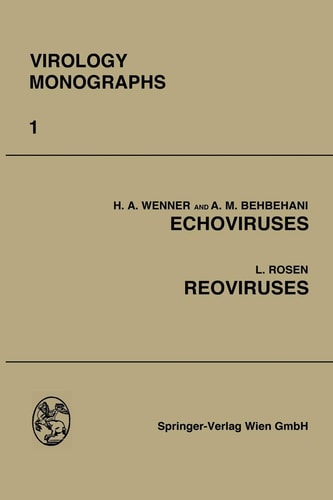
Echoviruses and Reoviruses
0
0
As an Amazon Associate and affiliate partner, Menrva Books earns from qualifying purchases. Learn more
Author Description
The ECHO viruses (enteric cytopathogenic human orphan viruses) comprise a subgroup of the human enteroviruses: all are infectious for human beings. Although several may share common antigens, most are serologically unrelated. They have been grouped together with polio-and Coxsackie viruses because of similar physico-chemical properties, and because they are recoverable from the alimentary tract of human beings. Since 1951 when the first was recognized (ROBBINS et al., 1951),32 more have been discovered. In re cent years 2 members of the group have been placed in other categories: ECHO 10 is now reovirus type 1 (SABIN, 1959), and ECHO 28 is a rhinovirus, provisionally type 1 (TYRRELL and CHANOOK, 1963). During the last 15 years numerous studies have brought to light much information on the properties, ecology and natural history of the ECHO viruses. H. Historical Resume Two conspicuous events fostered the rapid acquisition of knowledge of ECHO viruses. The first was aresurging interest in tissue culture methods permissive of viral growth in vitro (ENDERs et al., 1949); the second was the introduction of mass vaccination against poliomyelitis (FRANCIS et al., 1957). Both events enabled further recognition and delineation of the etiology of illnesses simulating nonparalytic poliomyelitis.
Page Count:
108
Publication Date:
1968-01-01
Publisher:
Springer Berlin Heidelberg
ISBN-10:
3662238772
ISBN-13:
9783662238776
