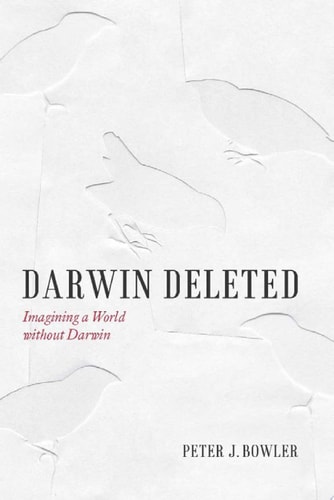
Darwin Deleted
0
0
As an Amazon Associate and affiliate partner, Menrva Books earns from qualifying purchases. Learn more
Author Description
The ideas and terminology of Darwinism are so pervasive these days that it seems impossible to avoid them, let alone imagine a world without them. But in this remarkable rethinking of scientific history, Peter J. Bowler does just that. He asks: What if Charles Darwin had not returned from the voyage of the Beagle and thus did not write On the Origin of Species? Would someone else, such as Alfred Russel Wallace, have published the selection theory and initiated a similar transformation? Or would the absence of Darwin’s book have led to a different sequence of events, in which biology developed along a track that did not precipitate a great debate about the impact of evolutionism? Would there have been anything equivalent to social Darwinism, and if so would the alternatives have been less pernicious and misappropriated? In Darwin Deleted, Bowler argues that no one else, not even Wallace, was in a position to duplicate Darwin’s complete theory of evolution by natural selection. Evolutionary biology would almost certainly have emerged, but through alternative theories, which were frequently promoted by scientists, religious thinkers, and moralists who feared the implications of natural selection. Because non-Darwinian elements of evolutionism flourished for a time in the real world, it is possible to plausibly imagine how they might have developed, particularly if the theory of natural selection had not emerged until decades after the acceptance of the basic idea of evolution. Bowler’s unique approach enables him to clearly explain the non-Darwinian tradition—and in doing so, he reveals how the reception of Darwinism was historically contingent. By taking Darwin out of the equation, Bowler is able to fully elucidate the ideas of other scientists, such as Richard Owen and Thomas Huxley, whose work has often been misunderstood because of their distinctive responses to Darwin. Darwin Deleted boldly offers a new vision of scientific history. It is one where the sequence of
Page Count:
336
Publication Date:
2013-03-22
Publisher:
University of Chicago Press
ISBN-10:
022600984X
ISBN-13:
9780226009841
Community Tags
Other Editions(2)
Reader Comments
Share Your Thoughts
No comments yet. Be the first to share your thoughts!