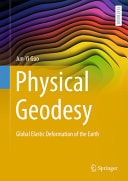
Physical Geodesy: Global Elastic Deformation of the Earth
0
0
As an Amazon Associate and affiliate partner, Menrva Books earns from qualifying purchases. Learn more
Author Description
This book aims to provide, with comprehensive detail, the fundamental theory of the Earth's global elastic deformation, as well as the associated variations of the gravity field and rotation, that the readers can thoroughly understand with little reference to other books or journal papers. Its contents belong to the essential background physics of geodesy nowadays. The noteworthy style of this book is its inclusion of ample intermediate steps of mathematical derivations and physical interpretations of the mathematical formulae not found elsewhere. It is based on undergraduate mathematics and physics as usually taught to mathematics- or physics-heavy majors. No university-level Earth science knowledge is assumed; the most elementary is provided concisely to the depth required. Mathematics and physics above the level mentioned, notably, vector and tensor analysis, spherical harmonics, elasticity, and solid body rotation, are treated to sufficient depth for preparing the readers to understand the relevant publications on theoretical formulation. Gravity and shape of the Earth are essential for the deformation theory. Seismology relies on the theory of the elastic deformation of the Earth; the density and elastic parameters of the Earth are determined using seismic data. Therefore, gravity and seismology are also treated adequately. Specifically, the free oscillation of the Earth, which is a kind of global elastic deformation, is treated to a depth and detail rarely found in books of seismology. After all these preparations, the elastic deformation theories of the Earth tide and surface loading are developed. The formulation of the respective Love numbers, as well as their roles in the Earth rotation theory, is emphasized. Plenty of details on the methods and implementations of numerical computations are included. The topics covered are fundamental and common for theoretical geodesists devoted to studying global geophysical processes. Besides, also provided ar
Menrva's Summary
THE THESIS
This book investigates the fundamental theory of the Earth's global elastic deformation and its impact on gravity and rotation. The author, Jun-Yi Guo, aims to provide a comprehensive understanding of these concepts, assuming only undergraduate-level mathematics and physics, with no prior Earth science knowledge required. The text meticulously details mathematical derivations and physical interpretations, treating advanced topics like vector and tensor analysis, spherical harmonics, elasticity, and solid body rotation to prepare readers for current publications. It also covers essential background in gravity, shape of the Earth, and seismology, including the free oscillation of the Earth, to fully explain the elastic deformation theories of Earth tides and surface loading.
THE SCOPE MAP
- Fundamental theory of Earth's global elastic deformation
- Associated variations of the gravity field
- Associated variations of Earth's rotation
- Inclusion of intermediate mathematical derivation steps
- Physical interpretations of mathematical formulae
- Treatment of vector and tensor analysis, spherical harmonics, elasticity, and solid body rotation
- Coverage of gravity, Earth's shape, and seismology
- Detailed treatment of Earth's free oscillation and its relation to global elastic deformation
THE AUTHORITY PERSPECTIVE
The book is positioned as an essential background text for modern geodesy, offering a thorough theoretical foundation for studying global geophysical processes. Its detailed mathematical derivations and physical interpretations are highlighted as unique features, making advanced concepts accessible to students with a strong undergraduate science background. The comprehensive approach, covering related fields like seismology and gravity, suggests it serves as a self-contained resource for theoretical geodesists. The inclusion of numerical computation methods indicates a practical application focus alongside theoretical depth.
Page Count:
710
Publication Date:
2025-11-24
Publisher:
Springer Nature Switzerland
ISBN-10:
3032066522
ISBN-13:
9783032066527
Science
Non-Fiction
Mathematics
Geophysics
Seismology
Elasticity
Earth Science
Physics
Community Tags
Similar Books