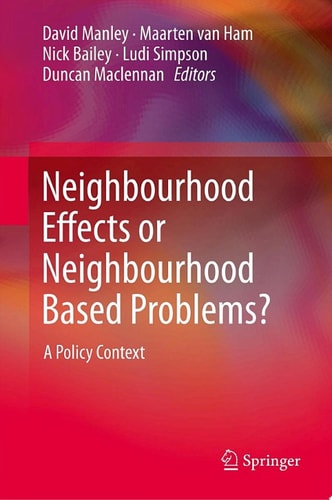
Neighbourhood Effects or Neighbourhood Based Problems?
0
0
As an Amazon Associate and affiliate partner, Menrva Books earns from qualifying purchases. Learn more
Author Description
This edited volume critically examines the link between area based policies, neighbourhood based problems, and neighbourhood effects: the idea that living in disadvantaged neighbourhoods has a negative effect on residents’ life chances over and above the effect of their individual characteristics. Over the last few decades, Western governments have persistently pursued area based policies to fight such effects, despite a lack of evidence that they exist, or that these policies make a difference. The first part of this book presents case studies of perceived neighbourhood based problems in the domains of crime; health; educational outcomes; and employment. The second part of the book presents an international overview of the policies that different governments have implemented in response to these neighbourhood based problems, and discusses the theoretical and conceptual processes behind place based policy making. Case studies are drawn from a diverse range of countries including the United Kingdom, The Netherlands, Australia, Canada, and the USA.
Menrva's Summary
THE THESIS
This edited volume critically examines the complex relationship between area-based policies, neighborhood-based problems, and the concept of neighborhood effects. The book investigates the idea that residing in disadvantaged neighborhoods negatively impacts residents' life chances beyond their individual characteristics, a notion that has driven persistent area-based policies in Western governments despite limited evidence of their efficacy. It presents case studies of perceived neighborhood problems in crime, health, education, and employment, followed by an international overview of government policies and the theoretical underpinnings of place-based policy-making.
THE SCOPE MAP
- Case studies of neighborhood-based problems in crime
- Case studies of neighborhood-based problems in health
- Case studies of neighborhood-based problems in educational outcomes
- Case studies of neighborhood-based problems in employment
- International overview of government policies implemented in response to neighborhood problems
- Discussion of theoretical and conceptual processes behind place-based policy making
- Case studies drawn from the United Kingdom, The Netherlands, Australia, Canada, and the USA
THE AUTHORITY PERSPECTIVE
This collection of essays offers a critical examination of area-based policies and their purported impact on neighborhood disadvantage. The authors present a range of case studies and international policy reviews, questioning the evidence base for the existence of significant neighborhood effects and the effectiveness of policies designed to combat them. The book aims to provide a nuanced perspective on the challenges of place-based policy-making. The work is likely to be of interest to academics and policymakers involved in urban studies, sociology, and public policy.
Page Count:
296
Publication Date:
2013-06-26
Publisher:
Springer Nature
ISBN-10:
9400766955
ISBN-13:
9789400766952
Economics
Non-Fiction
Politics
Public Policy
Criminology
Health Studies
Education
Sociology
Urban Studies
Community Tags
Similar Books