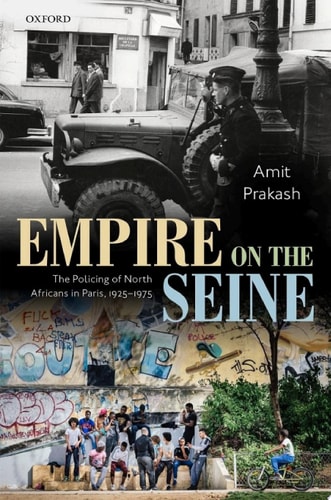
Empire on the Seine: The Policing of North Africans in Paris, 1925-1975
0
0
As an Amazon Associate and affiliate partner, Menrva Books earns from qualifying purchases. Learn more
Author Description
Why are relations between minorities and the police in France so fraught? Stripping away the myth that this tension is a sudden and recent disruption of its universalist republican tradition brought on by the presence of North African immigrants, Amit Prakash locates the origins of contemporary conflicts in race and empire in France's history. In Empire on the Seine, Prakash argues that the métropole and the colony dynamically co-developed a policing regime over the course of the nineteenth and twentieth centuries to manage colonial and racial difference. With the North African community emerging as a sizable and durable presence in Paris after World War I, this policing became a key state practice in imagining and administering the immigrant population. Prakash shows that despite the French state's current reluctance to use race as an official category, racial thought and racial targets animated police services, social services, and urban planning schemes from the 1920s until the 1970s. Using police archival records, reports from colonial officials, urban planning and housing studies, and the records of French social workers and immigrant associations, Prakash shows that colonial racism was integrated into the policing of Paris and that architecture, urbanism, and social housing assumed police functions for colonial and postcolonial migrants. In light of this history, contemporary social and racial segregation, periodic protests and rioting against police violence, and the aggressive posture of the Parisian police emerge as the material traces of French colonialism in the métropole. The city of Paris was the capital of an empire and its imperial shadows are long.
Menrva's Summary
THE THESIS
This book investigates the historical origins of contemporary tensions between the French police and North African minority populations in Paris. Amit Prakash, a scholar of modern European history, challenges the notion that these conflicts are recent phenomena. By analyzing the co-development of policing regimes in the métropole and the colonies, he argues that racialized state practices were systematically integrated into urban planning, social services, and law enforcement from the 1920s through the 1970s.
THE SCOPE MAP
What You Will Find
- Analysis of the policing of North African immigrants in Paris between 1925 and 1975.
- Examination of how urban architecture and social housing were utilized as tools for surveillance and control.
- Integration of police archival records, colonial reports, and documentation from immigrant associations.
Scope Limits
- The study focuses primarily on the Parisian context rather than a comprehensive national survey of all French territories.
- The analysis concludes in the 1970s, leaving contemporary post-1975 developments to be inferred from the established historical framework.
THE AUTHORITY PERSPECTIVE
Experts recognize this work as a significant contribution to the study of French colonial history and the institutionalization of racialized policing. Readers frequently note the academic density of the prose and the depth of the archival research presented throughout the text.
Page Count:
281
Publication Date:
2022-01-01
Publisher:
OUP Oxford
ISBN-10:
019265425X
ISBN-13:
9780192654250
Politics
History
Specific Topics
Modern History
European History
Urban Studies
Criminology
World politics
Sociology
Europe
Community Tags
Similar Books