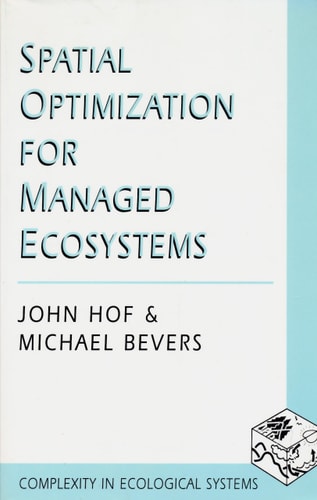
Spatial Optimization for Managed Ecosystems
0
0
As an Amazon Associate and affiliate partner, Menrva Books earns from qualifying purchases. Learn more
Author Description
Spatial optimization is a methodology used to maximize or minimize a management objective, given the limited area, finite resources, and spatial relationships in an ecosystem. Optimization approaches can be used to evaluate a great variety of options and allow tradeoff analyses that might be impossible with other methods. This book presents ideas and methods for directly optimizing the spatial layout of the landscape features in which an ecosystem functions. The problems Hof and Bevers address are complex, and the book relies heavily on mathematical presentations; the ideas are explained in a tutorial fashion that allows readers to grasp the general principals even if they skip the math. The first of four parts treats static spatial relationships that reflect the importance of shape, size, and proximity within an ecosystem. Part 2 considers spatial autocorrelation in a chance-constrained modeling framework. Part 3 discusses dynamic spatial changes within modeled ecosystems, and the final section focuses on diversity and sustainability. Although most discussion concerns wildlife habitat issues, the authors also include chapters on recreation, timber management, water runoff, and pest management.
Menrva's Summary
THE THESIS
This book explores the application of spatial optimization techniques to manage ecosystems effectively. The authors, John G. Hof and Michael Bevers, present methods for directly optimizing the spatial layout of landscape features within ecosystems, addressing complex problems that require mathematical rigor. The book is structured into four parts, beginning with static spatial relationships and progressing to dynamic changes, diversity, and sustainability, while offering a tutorial approach to mathematical concepts.
THE SCOPE MAP
- Methodologies for maximizing or minimizing management objectives in ecosystems.
- Analysis of static spatial relationships including shape, size, and proximity.
- Spatial autocorrelation within a chance-constrained modeling framework.
- Dynamic spatial changes and temporal considerations in ecosystem modeling.
- Approaches to diversity and sustainability in ecosystem management.
- Applications in wildlife habitat, recreation, timber, water runoff, and pest management.
THE AUTHORITY PERSPECTIVE
The book presents complex mathematical approaches to spatial optimization in ecosystem management, offering a tutorial style to make the concepts accessible. It covers a range of applications from wildlife habitat to resource management, indicating a comprehensive scope for professionals and researchers in the field. The detailed mathematical presentations suggest a text geared towards those with a strong quantitative background, while the tutorial approach aims to broaden its reach.
Page Count:
258
Publication Date:
1998-01-01
Publisher:
Columbia University Press
ISBN-10:
023110636X
ISBN-13:
9780231106368
Science
Non-Fiction
Mathematical Modeling
Community Tags
Similar Books