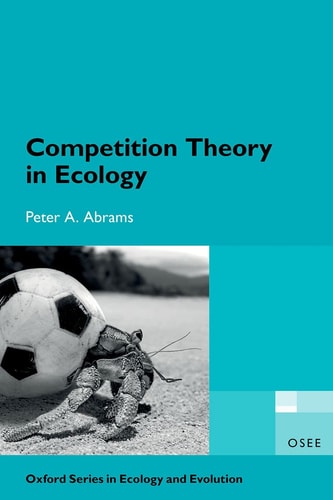
Competition Theory in Ecology
0
0
As an Amazon Associate and affiliate partner, Menrva Books earns from qualifying purchases. Learn more
Author Description
Competition between species arises when two or more species share at least some of the same limited resources. It is likely to affect all species, as well as many higher-level aspects of community and ecosystem dynamics. Interspecific competition shares many of the same features as density dependence (intraspecific competition) and evolution (competition between genotypes). In spite of this, a robust theoretical framework is not yet in place to develop a more coherent understanding of this important interaction. Despite its prominence in the ecological literature, the theory seems to have lost direction in recent decades, with many synthetic papers promoting outdated ideas, failing to use resource-based models, and having little utility in applied fields such as conservation and environmental management. Competition theory has done little to incorporate new findings regarding consumer-resource interactions in the context of larger food webs containing behaviourally or evolutionarily adapting components. Overly simple models and methods of analysis continue to be influential.Competition Theory in Ecology represents a timely opportunity to address these shortcomings and suggests a more useful approach to modelling that can provide a basis for future models that have greater predictive ability in both ecology and evolution. The book concludes with some broader observations on the lack of agreement on general principles to use in constructing mathematical models to help understand ecological systems. It argues that a more open discussion and debate of the underlying structure of ecological theory is now urgently required to move the field forward.
Menrva's Summary
THE THESIS
This book investigates the current state of competition theory in ecology, questioning why a robust, predictive framework remains elusive despite the ubiquity of interspecific competition. Peter A. Abrams, a prominent researcher in theoretical ecology, utilizes his extensive background in consumer-resource dynamics to critique existing models. He argues that the field has stagnated due to an over-reliance on overly simple mathematical structures and a failure to integrate modern findings regarding behavioral and evolutionary adaptations within complex food webs.
THE SCOPE MAP
What You Will Find
- Analysis of density dependence and interspecific competition models
- Critique of current synthetic ecological literature
- Frameworks for incorporating consumer-resource interactions into larger food webs
- Methodologies for improving the predictive capacity of ecological models
Scope Limits
- Does not provide a singular, unified theory of ecology
- Does not focus on empirical field data collection techniques
THE AUTHORITY PERSPECTIVE
Experts recognize this work as a critical intervention in theoretical ecology that challenges established modeling conventions. Readers frequently note the high level of mathematical and conceptual density, making it a text primarily suited for advanced students and professional researchers in the field.
Page Count:
336
Publication Date:
2022-12-22
Publisher:
Oxford University Press
ISBN-10:
0192895532
ISBN-13:
9780192895530
Science
Evolutionary Biology
Ecology
Mathematical Modeling
Community Tags
Similar Books