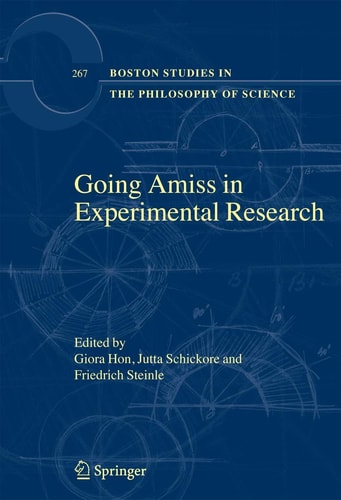
Going Amiss in Experimental Research
0
0
As an Amazon Associate and affiliate partner, Menrva Books earns from qualifying purchases. Learn more
Author Description
Like any goal-oriented procedure, experiment is subject to many kinds of failures. These failures have a variety of features, depending on the particulars of their sources. For the experimenter these pitfalls should be avoided and their effects minimized. For the historian-philosopher of science and the science educator, on the other hand, they are instructive starting points for reflecting on science in general and scientific method and practice in particular. Often more is learned from failure than from confirmation and successful application. The identification of error, its source, its context, and its treatment shed light on both practices and epistemic claims. This book shows that it is fruitful to bring to light forgotten and lost failures, subject them to analysis and learn from their moral. The study of failures, errors, pitfalls and mistakes helps us understand the way knowledge is pursued and indeed generated. The book presents both historical accounts and philosophical analyses of failures in experimental practice. It covers topics such as "error as an object of study", "learning from error", "concepts and dead ends", "instrumental artifacts", and "surprise and puzzlement". This book will be of interest to historians, philosophers, and sociologists of science as well as to practicing scientists and science educators.
Menrva's Summary
THE THESIS
Failures in experimental research offer profound insights into the nature of scientific knowledge and practice. This book argues that by analyzing forgotten and lost experimental failures, we can learn more about how scientific knowledge is pursued and generated than from successes alone. The authors, drawing on historical accounts and philosophical analyses, explore various facets of error, including its identification, source, context, and treatment. The work covers topics such as error as an object of study, learning from mistakes, conceptual dead ends, instrumental artifacts, and the role of surprise in scientific discovery.
THE SCOPE MAP
- Error as an object of study in scientific practice
- The process and value of learning from experimental error
- Conceptual dead ends and their impact on research
- The role of instrumental artifacts in generating errors
- Surprise and puzzlement as catalysts for scientific insight
- Historical accounts and philosophical analyses of experimental failures
THE AUTHORITY PERSPECTIVE
This book is likely to be of significant interest to historians, philosophers, and sociologists of science, as well as practicing scientists and science educators. The approach of studying failures rather than successes offers a unique perspective on the scientific method and the generation of knowledge. The blend of historical case studies and philosophical analysis provides a comprehensive examination of the topic. The work aims to illuminate the practices and epistemic claims of science through the lens of what goes wrong.
Page Count:
277
Publication Date:
2010-10-22
Publisher:
Springer Netherlands
ISBN-10:
9048180198
ISBN-13:
9789048180196
History
Philosophy
Non-Fiction
Scientific Method
Community Tags
Similar Books