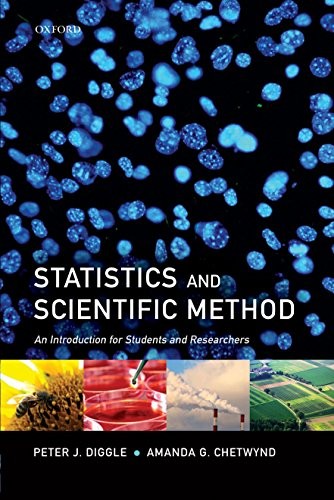
Statistics and Scientific Method
0
0
As an Amazon Associate and affiliate partner, Menrva Books earns from qualifying purchases. Learn more
Author Description
Most introductory statistics text-books are written either in a highly mathematical style for an intended readership of mathematics undergraduate students, or in a recipe-book style for an intended audience of non-mathematically inclined undergraduate or postgraduate students, typically in a single discipline; hence, "statistics for biologists", "statistics for psychologists", and so on. An antidote to technique-oriented service courses, Statistics and Scientific Method is different. It studiously avoids the recipe-book style and keeps algebraic details of specific statistical methods to the minimum extent necessary to understand the underlying concepts. Instead, the text aims to give the reader a clear understanding of how core statistical ideas of experimental design, modelling and data analysis are integral to the scientific method. Aimed primarily at beginning postgraduate students across a range of scientific disciplines (albeit with a bias towards the biological, environmental and health sciences), it therefore assumes some maturity of understanding of scientific method, but does not require any prior knowledge of statistics, or any mathematical knowledge beyond basic algebra and a willingness to come to terms with mathematical notation. Any statistical analysis of a realistically sized data-set requires the use of specially written computer software. An Appendix introduces the reader to our open-source software of choice, R, whilst the book's web-page includes downloadable data and R code that enables the reader to reproduce all of the analyses in the book and, with easy modifications, to adapt the code to analyse their own data if they wish. However, the book is not intended to be a textbook on statistical computing, and all of the material in the book can be understood without using either R or any other computer software
Menrva's Summary
THE THESIS
This book investigates how core statistical ideas are integral to the scientific method. It aims to provide readers, particularly beginning postgraduate students in biological, environmental, and health sciences, with a clear understanding of experimental design, modeling, and data analysis. The text avoids a purely technique-oriented approach, minimizing algebraic details to focus on underlying concepts, and assumes a basic understanding of scientific method but no prior statistical knowledge beyond basic algebra. The book also introduces the R statistical software and provides resources for readers to replicate analyses and apply them to their own data.
THE SCOPE MAP
- Core statistical ideas of experimental design, modeling, and data analysis.
- A focus on understanding underlying concepts rather than memorizing techniques.
- Application of statistical principles to the scientific method across various disciplines.
- Introduction to the R open-source statistical software.
- Downloadable data and R code for reproducing book analyses.
- Adaptable code for readers to analyze their own data.
THE AUTHORITY PERSPECTIVE
The book is positioned as an antidote to technique-oriented service courses, aiming to provide a conceptual understanding of statistics within the scientific method. It is primarily targeted at beginning postgraduate students, particularly those in biological, environmental, and health sciences, assuming some maturity in scientific method but not prior statistical knowledge. The approach emphasizes conceptual understanding over detailed algebraic manipulation, making it distinct from typical recipe-book style statistics texts. Resources for using R and analyzing data are provided to support practical application.
Page Count:
172
Publication Date:
2011-01-01
ISBN-10:
0199543194
ISBN-13:
9780199543199
Science
Non-Fiction
Statistics
Data Analysis
Research Methods
Scientific Method
Community Tags
Similar Books